
The Tinnitus Relief Roadmap
A free 8-page expert guide with science-based tips to help you reduce panic, avoid common mistakes, and know what to do next.
1. Essential checks to rule out medical red flags
What to do first, today, tonight, this week, and longer term.
First: check for medical red flags. Visit Doctor or ENT urgently when any of these apply:
☐ Sudden hearing loss (within hours to 3 days).
☐ New neurological symptoms: facial numbness, speech/vision changes, severe imbalance.
☐ Severe vertigo with hearing change (room spinning, tilting, vomiting).
☐ Suicidal thoughts, inability to function/sleep due to distress.
☐ I understand this guide is not a medical diagnosis.
All other cases:
☐ Visit your primary care doctor for a check-up (including blood pressure).
☐ Have your hearing tested at an audiologist (obtain audiogram).
☐ Visit an ENT if you experience dizziness, vertigo, imbalance, or neurological symptoms. If you have asymmetric hearing loss, an MRI may be considered when there is more than a 15 dB difference between ears at any 2 adjacent frequencies. Pulsatile tinnitus (tinnitus pulsating with heartbeat) is also an indication for ENT visit.
Today: stop feeding the panic loop
☐ I will stop checking whether the sound is still there.
☐ I will not test tinnitus in silence today.
☐ I will not panic-Google or read horror stories today.
☐ I will use gentle background sound if silence makes tinnitus feel worse.
☐ I will do one normal activity while tinnitus is present.
Tonight: protect sleep
☐ I will use soft neutral sound if needed.
☐ I will not research tinnitus in bed.
☐ I will not measure the sound while trying to sleep.
☐ My goal tonight is rest, not solving tinnitus.
This week: reduce tinnitus control over your life
☐ I will restart one normal activity I have been avoiding (only if your energy is sufficient, do not force anything).
☐ I will stop comparing today’s tinnitus to yesterday’s.
☐ I will focus on reducing the impact of tinnitus instead of trying to force silence.
☐ I will choose structured education over random cure-hunting.
Longer term: follow a structured path
☐ If tinnitus affects my sleep, mood, work, focus, or daily life, I will consider structured help.
☐ I understand that even though no cures exist, it is possible to retrain my brain to stop focusing on my tinnitus.
☐ This process is called habituation: your brain gradually stops treating tinnitus as a threat so it can fade into the background.
Leave your email below and I’ll send you this entire page as a PDF guide, as well as more information on the method I used to habituate and reduce my tinnitus from a 9/10 to a 1/10.
I’ll only send you the roadmap and helpful tips.
2. Common tinnitus mistakes to avoid
DO’s for tinnitus
☐ Stay physically active even if tinnitus fluctuates temporarily.
☐ Improve sleep quality with low-stimulation evenings and consistent routines.
☐ Use hearing protection selectively in genuinely loud environments.
☐ Use neutral background sounds rather than stimulating podcasts or music.
☐ Practice meditation or relaxation regularly to reduce stress.
☐ Eat reasonably healthy and reduce excessive alcohol intake.
☐ Reduce tinnitus monitoring/checking behaviors.
☐ Get your official Tinnitus Functional Index Test score hier.
☐ Trust habituation, and get help if you want a structured plan.
☐ Use scientifically grounded tinnitus information and qualified experts.
DONT’s for tinnitus
☐ Don’t panic or assume tinnitus means your life is over.
☐ Don’t endlessly read negative tinnitus forums and doom stories.
☐ Don’t constantly check, compare, or analyze the sound.
☐ Don’t overprotect your ears in normal sound environments.
☐ Don’t wear earplugs all night unless medically necessary.
☐ Don’t sleep with stimulating podcasts/music running continuously.
☐ Don’t doomscroll or use your phone in bed.
☐ Don’t rely on miracle cures, supplements, or influencer claims.
☐ Don’t stop exercising purely because tinnitus spikes temporarily.
☐ Don’t assume every spike means permanent damage or worsening.
When first aid is not enough
If tinnitus still affects your sleep, mood, concentration, work, or daily life, you likely need more than tips. You could benefit from a structured process that helps you accelerate tinnitus habituation. Leave your email below and I’ll send you my free 40-minute webinar that explains how to achieve lasting habituation so tinnitus fades into the background.
I’ll only send you the roadmap and helpful tips.
3. How to manage a tinnitus spike
What to do when tinnitus suddenly feels louder, scarier, or impossible to ignore.
Step 1: Name the spike
Literally say this: “This is a tinnitus spike. My job is to calm the reaction, not solve everything right now.” Naming the spike creates distance. Your future isn’t ruined.
☐ I named this as a spike, not a catastrophe.
Step 2: Stop measuring the sound
Say this: “Measuring keeps tinnitus important. I am not measuring it right now.”
☐ I don’t check whether it is getting louder and I don’t compare this spike to yesterday.
☐ I don’t sit in silence, cover one ear, or go to a quiet room to double-check it.
Step 3: Reduce contrast
If silence makes tinnitus stand out, add gentle background sound. You can download my free app with masking sounds here (Apple / Android). You can also open a window or a fan, or listen to your favorite music. Keep it gentle. The goal is not to overpower tinnitus.
☐ I added calm background sound if silence was making it worse.
Step 4: Block panic-searching
Do not search tinnitus forums, cure claims, horror stories, or symptom explanations while anxious. If you have a medical concern, write it down and contact a qualified professional.
☐ I did not panic-Google or read worst-case stories.
Step 5: Do one normal activity for 10 minutes
Choose one small activity and do it while tinnitus is present. Do a meditation, make tea, take a shower, take a walk, prepare food, read one page, tidy one small area, watch something calm, do something fun, or message someone about something unrelated to tinnitus.
☐ I did one normal activity while tinnitus was present and didn’t wait until the spike was gone.
Step 6: Use the spike script
Read this slowly: “This spike feels uncomfortable, but I do not need to solve my whole tinnitus problem right now. Checking, searching, and fighting will only keep my brain focused on it. My job is to respond calmly and teach my brain that this sound is not an emergency.”
☐ I used the spike script instead of arguing with the sound.
Step 7: Getting help is not failing
If tinnitus spikes, sleep problems, fear, or constant monitoring keep controlling your life, the next step is a structured approach. Leave your email below and I’ll share my 5-step tinnitus relief system with you I used to calm my tinnitus down from a 9/10 to a 1/10.
I’ll only send you the roadmap and helpful tips.
Bonus: Free app with masking sounds

One of the fastest ways to reduce the impact of tinnitus is to add a soft background sound. But not every sound works equally well. I created a free app with specialized masking sounds based on the sounds that helped me the most.
Checklist for masking sounds
☐ Download my free app leaving your email address below.
☐ Use your phone on speaker instead of headphones.
☐ Choose a sound you like.
☐ Set the volume as low as possible at first.
☐ If you do not get enough relief, increase the volume step by step.
☐ Louder is not necessarily better. The goal is to create a softer listening environment so your tinnitus is less noticeable.
☐ If you still do not get enough relief, try the cricket sound. It is more intense, but it can temporarily “quiet” tinnitus for some people, especially those with high-pitched tinnitus.
Next step: try a meditation
☐ Meditation can help calm your nervous system and reduce the attention you give to the tinnitus.
☐ Start by playing a masking sound you like. It continues during the meditation for added support.
☐ Sit comfortably in a chair or on a couch. You do not need to sit cross-legged.
☐ Start a meditation, follow the instructions, and focus on your breathing.
☐ With both hands, gently touch your index finger to your thumb.
☐ If this works well, you can also try meditating without a masking sound.
These quick techniques can help in the moment. When you are ready to move beyond temporary relief, leave your email below to receive this guide as PDF plus more information on how I got lasting relief by combining four different methods into one structured method.
I’ll only send you the roadmap and helpful tips.
Bonus: Jaw and neck exercises
For many people, tinnitus changes when they clench their jaw, move their neck, press around the jaw, or hold tension in their shoulders. This is often described as somatic tinnitus, meaning body tension or movement may influence the sound.
These exercises are meant to reduce tension. They should feel gentle. Do not force any movement, and stop if you feel pain, dizziness, pressure, or discomfort.
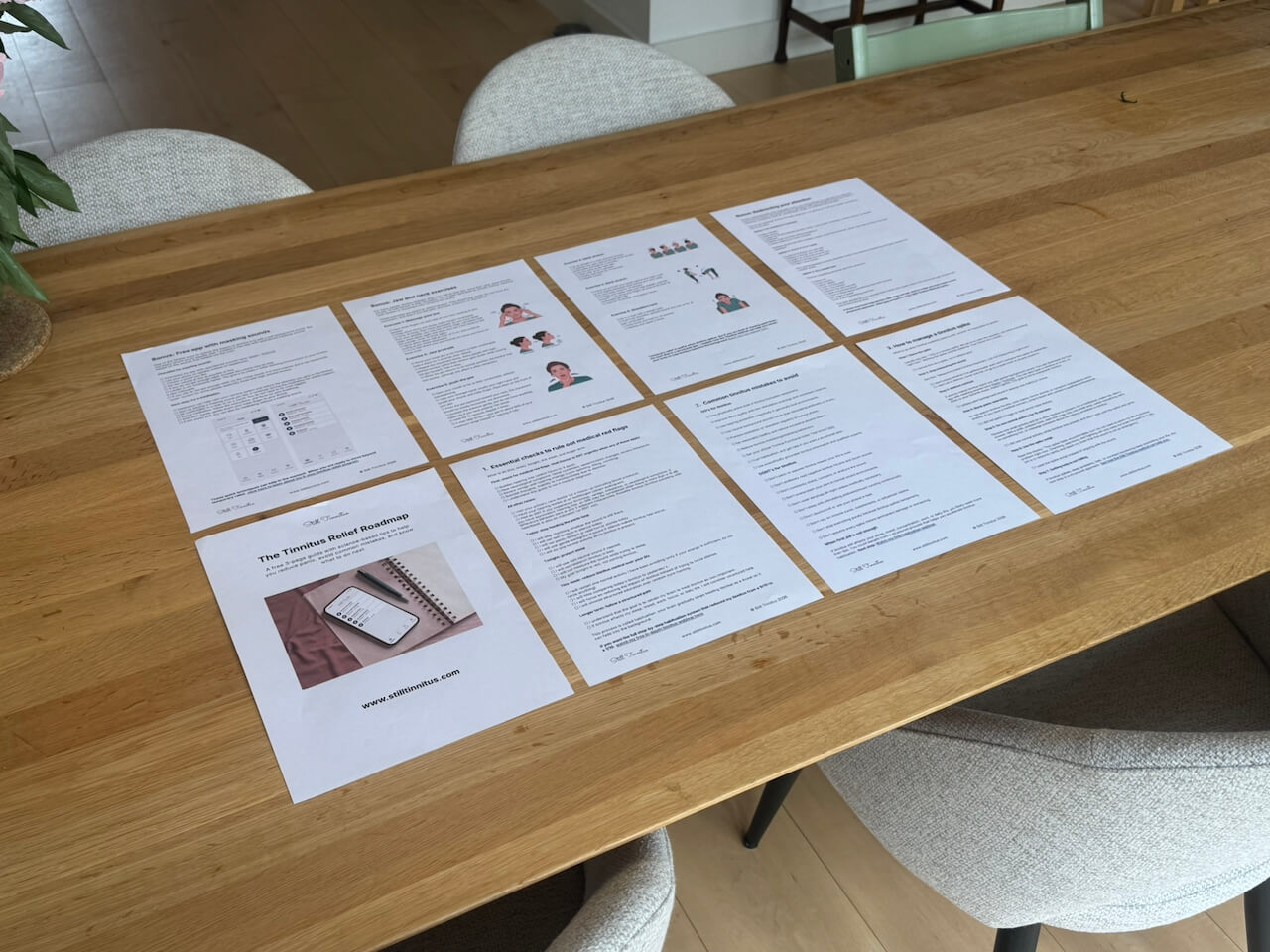
Exercise 1: Massage your jaw
☐ Place three fingers on each side of your face, starting at your temples.
☐ Press down firmly and slowly make circular movements.
☐ Circle 10 times, then move downward. As you move down from your temples, you may feel a bone ridge. Just below that ridge, press down again and open your jaw a few times to feel the muscles. Circle 10 times again.
☐ Move down about half an inch, or 2 cm, and continue circling as you move downward.
☐ Try to feel where your jaw muscles are tense and focus on those areas.
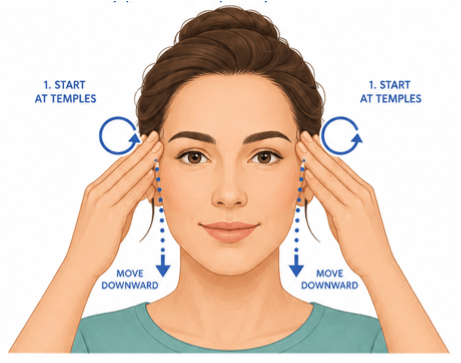
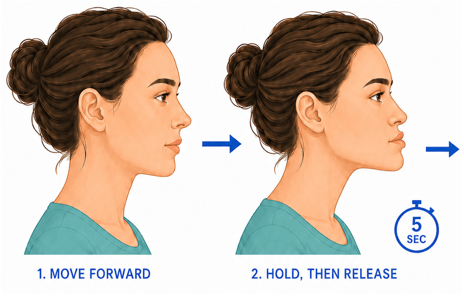
Exercise 2: Jaw protrude
☐ Move your lower jaw as far forward as feels comfortable. Hold it there for 5 seconds, then release.
☐ Repeat the movement slowly. Many people with high-pitched tinnitus notice their tinnitus gets louder while moving the jaw forward. That is okay.
☐ When the jaw returns to its normal position, the tinnitus may feel quieter, although this effect is often temporary.
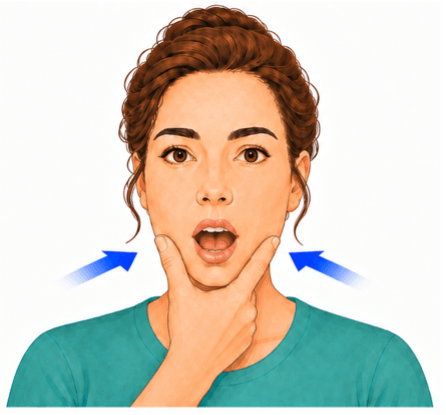
Exercise 3: push the jaw
☐ Open your mouth as far as feels comfortable, without overstretching.
☐ Take your stronger hand, usually your right hand, and spread your thumb and index finger. Place them on the front of your jaw.
☐ Press the jaw backward toward your neck. The movement should be mostly horizontal, not downward.
☐ Increase the pressure gently, but do not force anything, especially if you have existing TMJ issues.
☐ Hold for 30 seconds. Repeat 3 times.
☐ It may help to open your jaw to about 80% of your maximum range instead of opening it fully.
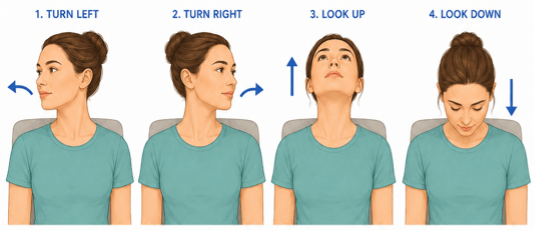
Exercise 4: Neck stretch
☐ Sit up straight in a chair and look forward.
☐ Carefully turn your neck to the left as far as feels comfortable and hold for 5 seconds.
☐ Do the same to the right side.
☐ Then look up for 5 seconds.
☐ Finally, look down for 10 seconds.
☐ Repeat 3 times.
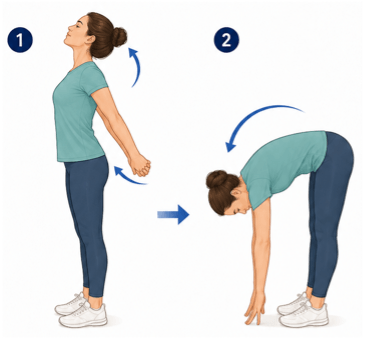
Exercise 5: Back stretch
☐ Stand up and hold your hands behind your back. Look up and slightly backward while pulling your arms away from your body. Hold for 10 seconds.
☐ Release your hands, keep your legs straight, and fold forward. Try to bring your fingers as close to the floor as comfortably possible.
☐ Hold for 10 seconds and repeat 3 times.
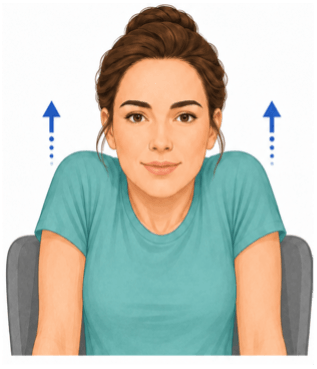
Exercise 6: Shoulders tuck
☐ Sit in a chair with a straight back.
☐ Push both shoulders upward toward your ears as far as feels comfortable.
☐ Press firmly and hold for 10 seconds.
☐ Release and repeat 3 times.
Temporary relief is useful when tinnitus spikes. But if you are tired of chasing quick fixes, the next step is a structured plan. I explain how my science-based method can help you retrain your brain to help tinnitus fade into the background. Watch the free webinar here.
I’ll only send you the roadmap and helpful tips.
Bonus: Redirecting your attention
Tinnitus often becomes more noticeable when your surroundings are quiet and your attention locks onto the sound. One practical way to get quick relief is to change the input your brain is receiving: movement, fresh air, conversation, a task, or a different environment.
This is not “ignoring” tinnitus through willpower. It is giving your nervous system something else to process.
Option 1: Go outside for 5 minutes
☐ Step outside.
☐ Walk slowly.
☐ Listen for three external sounds: traffic, wind, birds, footsteps, voices, leaves, or distant movement.
☐ Name what you hear without judging it.
☐ Keep walking for a few minutes.
Outdoor sound naturally creates a richer sound environment, which can make tinnitus feel less dominant.
Option 2: The 5-4-3-2-1 reset
☐ Look for 5 things you can see.
☐ Notice 4 things you can feel.
☐ Listen for 3 sounds around you.
☐ Notice 2 things you can smell.
☐ Take 1 slow breath.
This works because it moves attention away from internal monitoring and back toward the outside world.
Option 3: Do a simple task
Choose something physical and low-pressure:
☐ Make tea
☐ Fold laundry
☐ Water plants
☐ Take out the trash
☐ Tidy one surface
☐ Stretch for two minutes
☐ Walk around the block
☐ Text a friend about something else than tinnitus
☐ Prepare a snack
☐ Do a short breathing exercise
The task should be easy enough that it does not create stress, but active enough to interrupt the tinnitus focus loop.
If these exercises help but the relief does not last, that is a sign you may need a more structured approach. Leave your email below and I’ll send you this roadmap plus my 5-step method that has helped 1500+ people get lasting tinnitus relief.
I’ll only send you the roadmap and helpful tips.
Van hels kabaal naar stilte
Dit is mijn verhaal.
Hoi, ik ben Roel, biomedisch ingenieur en tinnitus expert. Ik kreeg tinnitus in mijn linkeroor tijdens een stressvolle periode en ging daarna door de meest frustrerende tijd van mijn leven.

Mijn huisarts zei: “het is niet te genezen, leer er maar mee leven”. Ik raakte in paniek, en probeerde vanalles uit wat ik op tinnitus forums tegen kwam. Ik slikte ginkgo biloba pillen en maskeerde mijn tinnitus met ruisgeluiden. Ik was constant bezig met mijn piep, maar niets hielp, en ik werd alsmaar wanhopiger.
Uit angst om het nog erger te maken, ging ik mijn oren steeds meer beschermen. Dat pakte verkeerd uit: ik ontwikkelde hyperacusis. Ik werd overgevoelig voor geluid en normale geluiden deden zelfs pijn. De combinatie van stress, angst en slaapgebrek bracht me uiteindelijk op een punt waarop ik er niet meer tegen kon.
Ik besloot te stoppen met vechten en ging me verdiepen in de beste tinnitus experts ter wereld. Ik wilde snappen wat er in mijn hoofd gebeurde om mijn piep te kalmeren. Ik probeerde verschillende wetenschappelijke behandelingen uit op mezelf en combineerde die tot een nieuwe methode.
Mijn methode werkte! Na een paar weken sliep ik al beter en voelde ik me minder gespannen. In de maanden daarna ging het met ups en downs: twee stappen vooruit, één stap terug. Maar naar verloop van tijd kwamen er steeds vaker momenten waarop het weer écht stil was in mijn hoofd.
These days, I sometimes still hear the ringing, but it no longer bothers me. I’ve returned to everything I had put on hold because of tinnitus. Would you like to get back to enjoying your life again? I’d be happy to help you! Leave your email below, and I’ll send you this roadmap and more helpful tips.
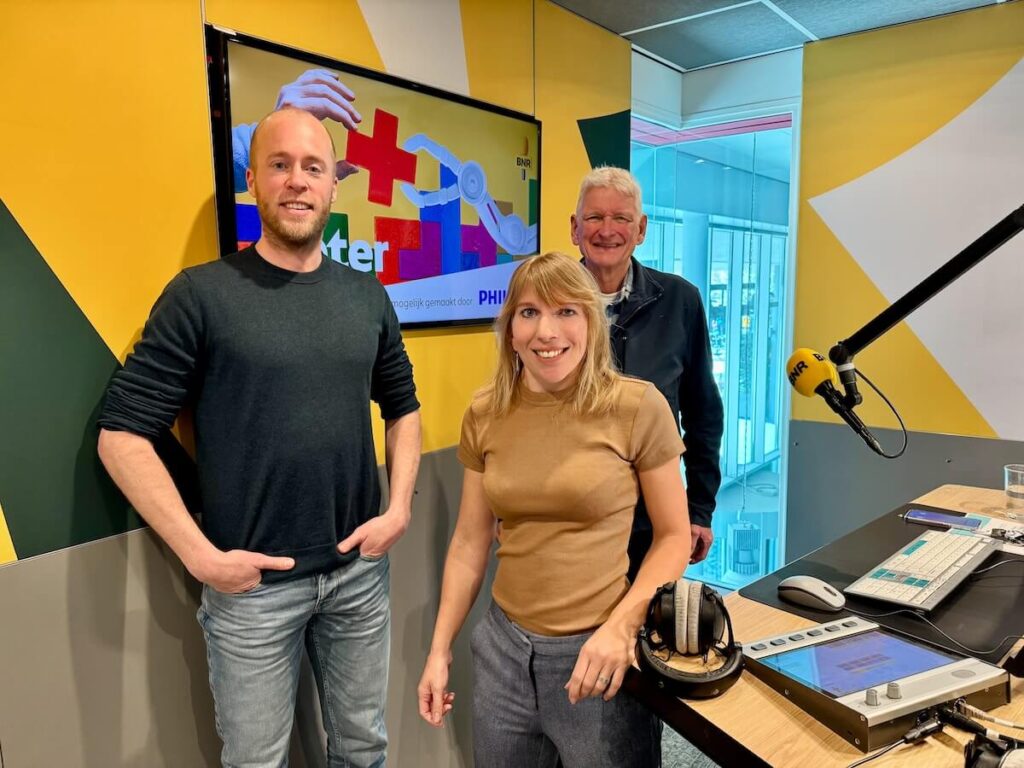
Roel van Gorkum, MS, and ENT physician Dr. Wielinga on air discussing the publication of our positive clinical trial results.
I hope this Tinnitus Relief Roadmap was helpful.
Just know that I’m here to help if you need it.
Take care!
Roel

Aisha, Still Tinnitus participant: “After completing the course, I genuinely feel different. The tinnitus hasn’t disappeared, but my relationship with it has changed completely. I feel calmer, less afraid, and much more in control. The sound no longer dominates my thoughts or emotions the way it used to.” Leave your email below and I’ll send you more reviews and testimonials of Still Tinnitus participants.


I’ll only send you the roadmap and helpful tips.
This guide is educational and is not a medical diagnosis. Contact a qualified medical professional, ENT, audiologist, or emergency service if tinnitus is sudden, one-sided, linked to sudden hearing loss, dizziness, injury, neurological symptoms, severe distress, or other concerning symptoms.
All content and media on the Still Tinnitus website is created and published for informational purposes only.
Privacyverklaring | Medische disclaimer | Algemene voorwaarden
© Still Tinnitus 2026