When you get tinnitus, it’s very common that you’re worried it will get worse as you get older. You probably know already that hearing loss increases with age and that hearing loss is linked to tinnitus. But does that mean your tinnitus will become more intense or more bothersome over time?
That assumption sounds logical. But I don’t like to work with assumptions. Scientific evidence tells a different story!
What Science Says About Tinnitus and Aging
When I was studying Tinnitus Retraining Therapy under Dr. Pawel Jastreboff, one of the world’s leading tinnitus researchers, I asked him the exact same question: “Dr. Jastreboff, does tinnitus get worse with age?”
Dr. Jastreboff’s answer was:
“The older, the more hearing loss. The more hearing loss, the greater the chance of getting tinnitus (and probably also how loud it sounds). But more hearing loss does not increase the chance of experiencing discomfort when hearing tinnitus. The amount of discomfort from tinnitus is not determined by the loudness of the tinnitus or the degree of hearing loss.”
He also provided me with data to back it up. Let’s take a look!
More Hearing Loss Increases Chance Of Hearing Tinnitus…
A large-scale study from Biswas et al. (2021) titled “Tinnitus prevalence in Europe: a multi-country cross-sectional population study” shows a clear trend: the percentage of people with tinnitus increases with age. For example, in the 55-64 age group, around 21% of both men and women report tinnitus.
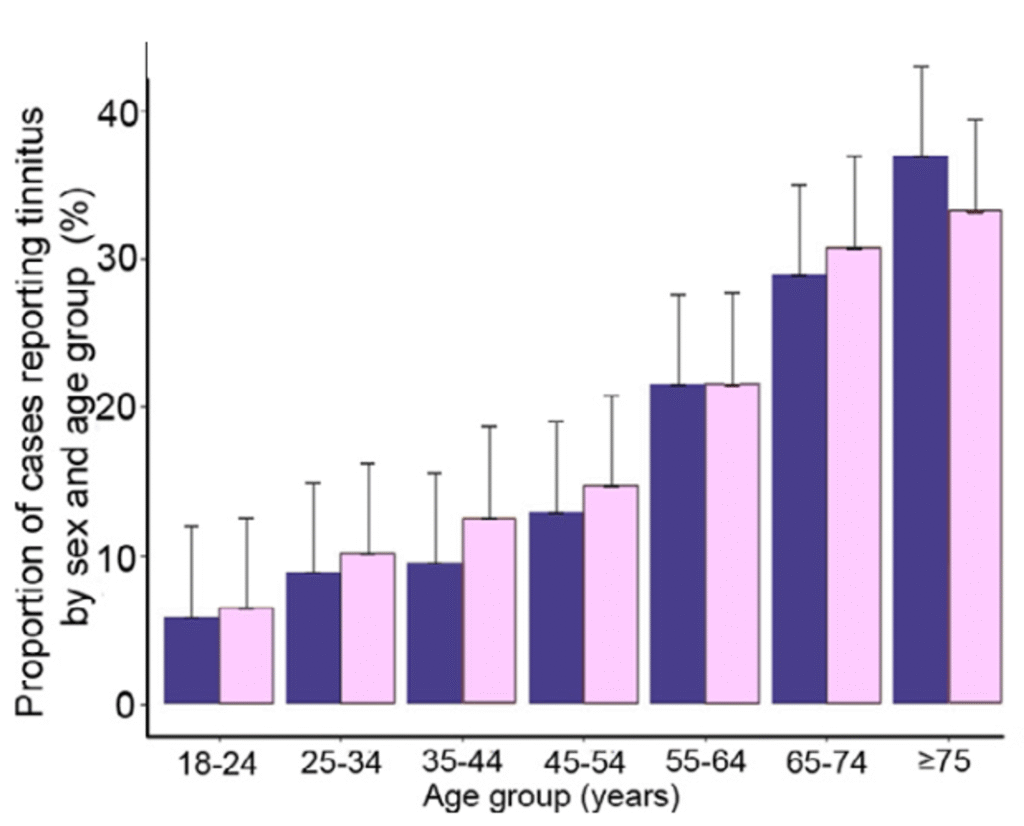
So you would think that tinnitus discomfort also increases with age, right?
Here’s where it gets interesting!
…But Tinnitus Discomfort Does Not Increase With Age
That’s not what you would expect!
Take a look at the chart below where:
- The blue line shows the percentage of people with any trouble hearing.
- The red line shows those with severe trouble hearing.
- The green line shows people experiencing bothersome tinnitus.
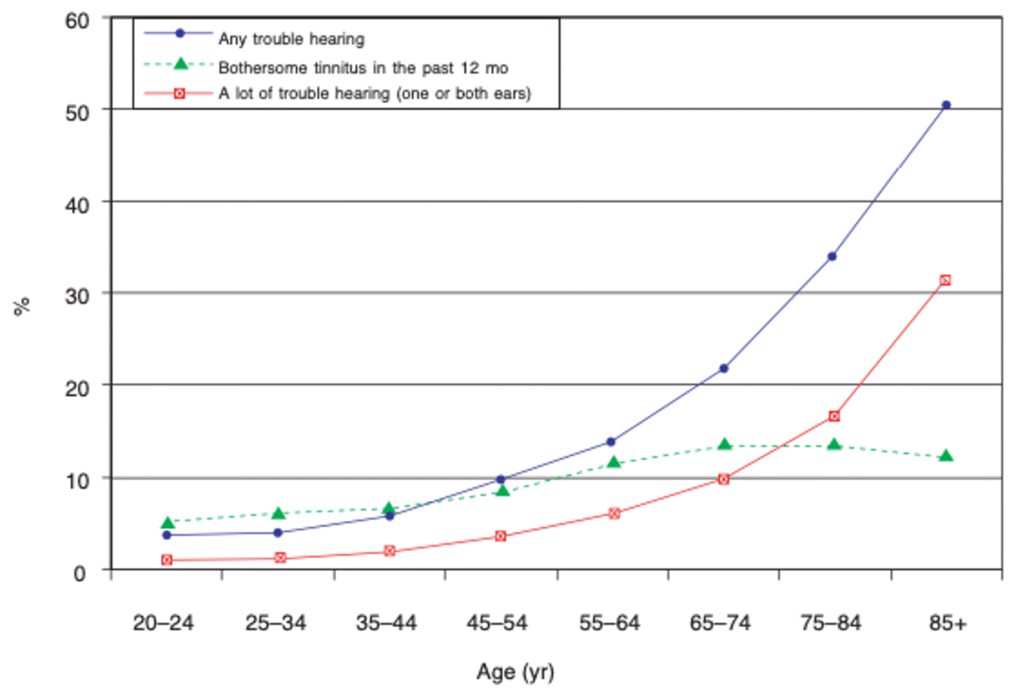
As expected, the blue and red lines rise with age because hearing loss increases with age. But the green line, the percentage of people who are bothered by tinnitus, does not move up in the same way. It even goes down at some point.
This means that:
- This data is cross-sectional. It compares age groups at a moment in time, not individuals over their lifespan. So it doesn’t mean your tinnitus will gradually worsen until age 65.
- Older people, despite worse hearing, are often less bothered by tinnitus.
- Tinnitus discomfort does not increase with hearing loss or age.
How Can You Prevent Tinnitus From Getting Worse With Age?
If tinnitus doesn’t have to get worse with age, why does it for some? Because of how they respond to it.
Over time, I see most tinnitus patients follow one of two paths: path A or path B.
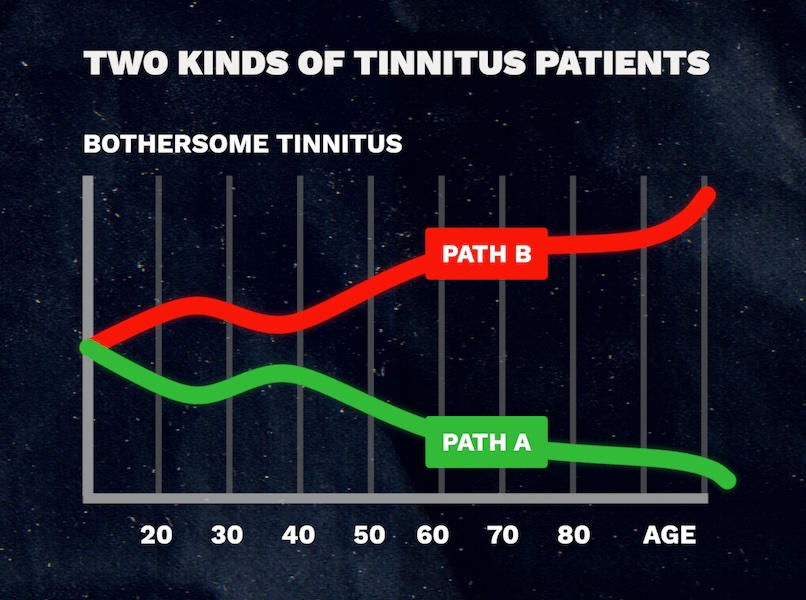
Path A: Tinnitus Gets Better Over Time
This group notices that their tinnitus doesn’t get better by itself. Tinnitus gives them stress, anxiety and sleep problems. But they get the right help. They learn the tools for tinnitus habituation. Therefore they don’t fear the sound anymore and stop running from it. They don’t continuously mask it with music, or with distracting. They know how to respond (and how not to), and their brain gradually tunes it out. Their tinnitus becomes less bothersome over time.
With the right tools, people on this path keep improving. Their bad days become rarer, and sometimes silence even comes back. This is also my path: my tinnitus went from a 9 to a 1 out of 10 and I even have completely silent days. I do everything I want from working out to festivals to drinking coffee and alcohol and it doesn’t upset my tinnitus anymore because I know what to do mentally.
Path B: Tinnitus Becomes More Bothersome Over Time
This group also has tinnitus that doesn’t go away by itself, but it does improve a bit. However, they often suffers for years without proper guidance because they found their ‘own way’ to deal with it. For example, they try to ignore the tinnitus, distract themselves with music, or chase alternative treatments. And it’s helping enough. But when life gets stressful, the sound flares up. And because they never really learned all the tinnitus habituation tools, their fear and frustration return. The old coping mechanisms stop working. Tinnitus starts to dominate their life again.
Thankfully, even if you’re on Path B, it’s never too late to learn and to switch to Path A.
Get On The Right Path
Whatever path you are on, I recommend joining my free tinnitus webinar. There, I will explain how the Still Tinnitus method can help you to calm your tinnitus and reclaim your life, without traveling, wait times, or group sessions. Even though there’s no cure for tinnitus, a full recovery is possible. Hang in there, and see you in the webinar!