The Still Tinnitus Course
Evidence-based tinnitus relief from home.
- No group therapy, wait times, or masking devices
- Based on four scientifically proven treatments
- Created by a biomedical engineer with tinnitus
- Rated 4.8/5 on Google




The Still Tinnitus Course
Evidence-based tinnitus relief from home.
- Based on four science-based treatments
- By a biomedical engineer with tinnitus
- No groups, wait times, or devices
- Rated 4.8/5 on Google
What is Still Tinnitus?
An online tinnitus treatment supported by science.
Still Tinnitus, meaning ‘to calm or quiet tinnitus’, is a scientifically validated, fully online, tinnitus treatment program that combines the four most-used tinnitus therapies:
- Cognitive Behavioural Therapy (CBT)
- Acceptance & Commitment Therapy (ACT)
- Mindfulness Based Stress Reduction (MBSR)
- Device-free Tinnitus Retraining Therapy (TRT)
Still Tinnitus is a comprehensive, self-paced online program without waitlists, travel, group therapy or the need to purchase ear-level noise generators. It’s reviewed and endorsed by healthcare professionals and developed over the past 6+ years by someone with tinnitus who truly understands your specific challenges.
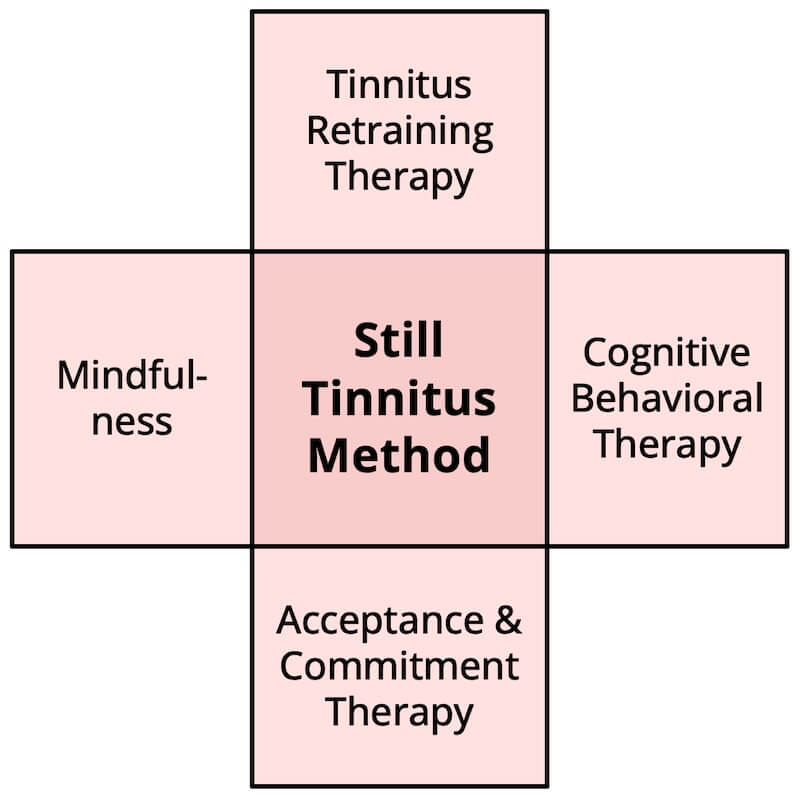
Still Tinnitus combines four tinnitus therapies.
Still Tinnitus combines 4 tinnitus therapies.
Key Benefits
A renewed sense of hope. No more social isolation.
For many people, tinnitus affects the same parts of daily life. Sleep becomes problematic, focusing is hard, frustration builds, and the mind stays locked in a struggle with the sound. The Still Tinnitus program is structured to reduce that struggle and provide the following benefits:

Restored Sleep
Still Tinnitus improves sleep quality and lowers stress, anxiety, and depressive thinking related to tinnitus.

Sit In Silence
You’ll learn all the tools needed to reduce tinnitus distress so you can stop running from the ringing and improve overall quality of life.

Better Concentration
Stop the constant mental chatter and improve your ability to work, focus, and re-engage in meaningful activities.
Restored Sleep
Still Tinnitus improves sleep quality and lowers stress, anxiety, and depressive thinking related to tinnitus.
Sit In Silence
You’ll learn all the tools needed to reduce tinnitus distress so you can stop running from the ringing and improve overall quality of life.
Better Concentration
Stop the constant mental chatter and improve your ability to work, focus, and re-engage in meaningful activities.
Validated By Research.
A peer-reviewed study showed that up to 90.9% of participants experienced a meaningful reduction in tinnitus distress (TFI). Read about the research→
Researched.
A peer-reviewed study showed that up to 90.9% of Still Tinnitus participants experienced a meaningful reduction in tinnitus distress (TFI). Read about the research→
Program Comparison
How Still Tinnitus compares to typical care.
The Still Tinnitus course is designed to make tinnitus relief more accessible. Compared to typical tinnitus care, it offers a structured, evidence-based approach at lower cost, with no wait times, travel requirements, or devices.
| Feature | Still Tinnitus Program | Typical Tinnitus Care |
|---|---|---|
| Effectiveness | High: peer-reviewed, delivered identically to all participants | Unknown: quality varies by clinic, therapist, and methods used |
| Typical costs | $799–$1,9991 | $4,500–$7,500 (US)2 |
| Science-based methods | 4 (CBT, ACT, MFN, TRT) | 1 or 23 |
| Devices required | Phone or computer only | Wearable maskers (~$4,000) |
| Wait times | None | Up to 12 months4 |
| Flexibility | Follow anywhere, anytime | Travel to clinic required |
| Trainer experience | Trainer has tinnitus | Typically does not |
| Feature | Still Tinnitus | Typical Care |
|---|---|---|
| Effectiveness | High: peer-reviewed, delivered identically to all participants | Unknown: quality varies by clinic, therapist, and methods used |
| Typical costs | $799–$1,9991 | $4,500–$7,500 (US)2 |
| Science-based methods | 4 (CBT, ACT, MFN, TRT) | 1 or 23 |
| Devices required | Phone or computer only | Wearable maskers (~$4,000) |
| Wait times | None | Up to 12 months4 |
| Flexibility | Follow anywhere, anytime | Travel to clinic required |
| Trainer experience | Trainer has tinnitus | Typically does not |
1 Prices depend on the chosen program and country of residence. Payment plans available (see FAQ).
2 Tinnitus care in the U.S. often includes initial consultations ($200–$500), follow-ups or therapy (5–10 sessions at $100–$300 each), and devices that can cost $4,000+ (e.g. Widex and similar brands). This can bring total costs to $4,500–$7,500+. The Still Tinnitus program provides a structured protocol with 1-on-1 support for $799–$1,999.
3 Still Tinnitus is based on four proven methods: Cognitive Behavioural Therapy, Acceptance & Commitment Therapy, Mindfulness, and Tinnitus Retraining Therapy (without devices).
4 Wait times for insurance-covered care can often reach 12 months or more.
Course Content
Get your life back from tinnitus in just 10 minutes a day.
It is recommended to spend around 10 minutes a day, or 1 hour a week on the course. At this pace it will take around 8 weeks to learn and practice the tools and skills used to support tinnitus habituation. As you keep using the techniques and guidance from the course in everyday life, most people find the tinnitus continues to improve over time.
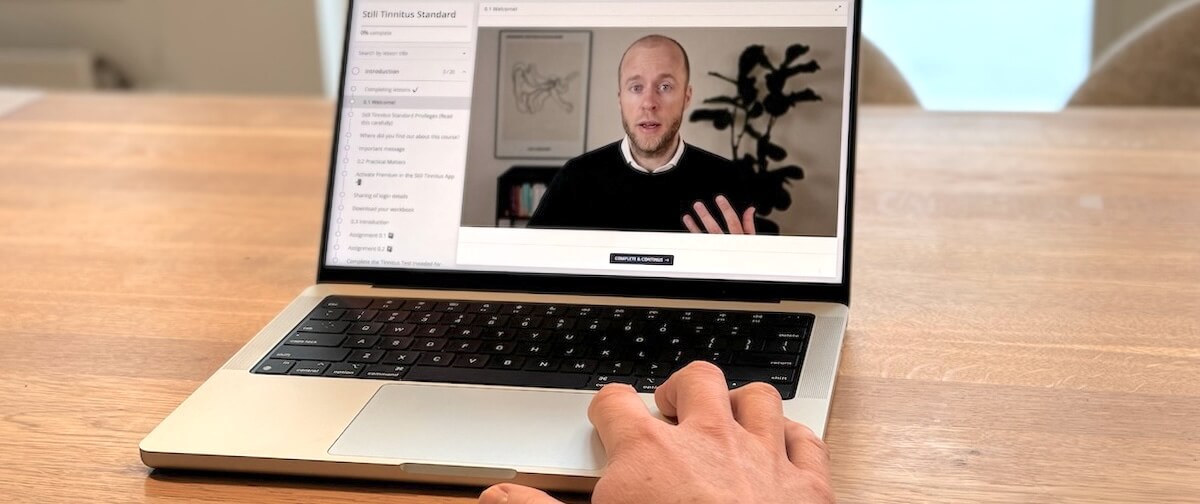
Online course videos
The course follows a 5-step structure and includes around 8 hours of video-based training, with optional modules such as hyperacusis (sound sensitivity).
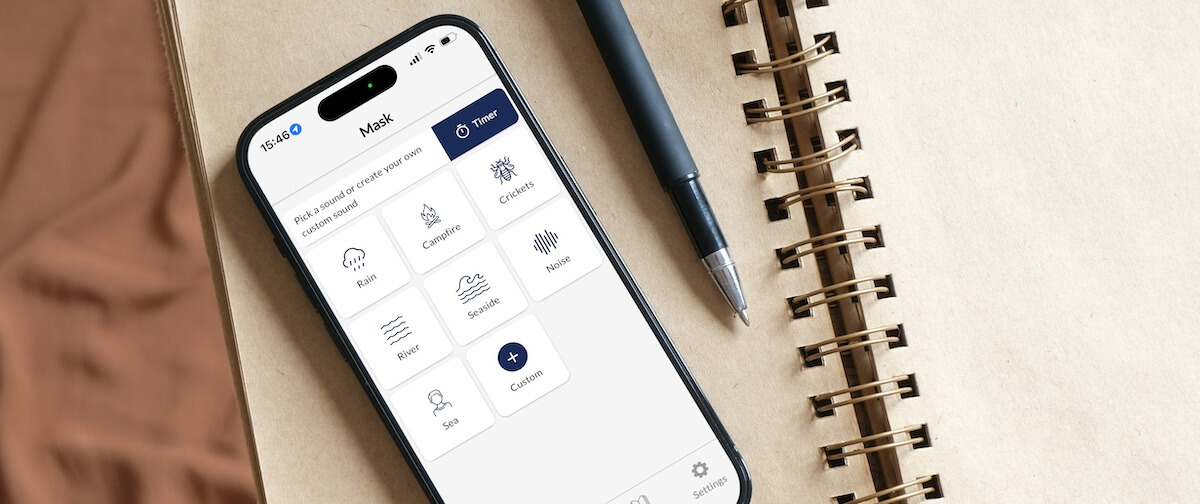
Workbook and app
An app and personal workbook with over 40 guided exercises, plus a wide range of evidence-based tips to help calm tinnitus, improve sleep, and reduce stress.

Personal support (optional)
Additional guidance is available through on-demand email support, audiogram analysis, and 1-on-1 coaching calls.
Online course videos
The course follows a 5-step structure and includes around 8 hours of video-based training, with optional modules such as hyperacusis (sound sensitivity).
Workbook and app
An app and personal workbook with over 40 guided exercises, plus a wide range of evidence-based tips to help calm tinnitus, improve sleep, and reduce stress.
Personal support (optional)
Additional guidance is available through on-demand email support, audiogram analysis, and 1-on-1 coaching calls.
TFI.
The Tinnitus Functional Index (TFI) is a 0–100 scale that measures tinnitus severity, categorizing its impact from “no problem” to “very big problem.” A reduction of 13 points or more is considered clinically meaningful and indicates a significant improvement in quality of life.
TFI.
The Tinnitus Functional Index (TFI) is a 0–100 scale that measures tinnitus severity, categorizing its impact from “no problem” to “very big problem.” A reduction of 13 points or more is considered clinically meaningful and indicates a significant improvement in quality of life.
Real World Validated Results
Clinically relevant improvement in up to 90.9% of participants.
Independent researchers at the University of Amsterdam (ACTA) evaluated changes in tinnitus among 122 Still Tinnitus course participants using the Tinnitus Functional Index (TFI). The study was peer-reviewed and published in the Journal of Clinical Medicine*.
Study results
- Of the patients with tinnitus duration up to 3 months, 90.9% showed a statistically significant improvement, with an average 37.6-point reduction on the TFI scale in 6 months (from 63.1 to 25.5 points).
- Across all participants, 74.6% achieved a clinically meaningful improvement with an average 27.2-point reduction (from 59.2 to 32.1 points) within the first 6 months
- On average, patients moved from the TFI category ‘big problem’ to ‘small problem’ within the first 6 months.
In practical terms, these changes reflect a substantial reduction in tinnitus-related distress and a meaningful improvement in quality of life over a relatively short period of time.
Tinnitus Improvement
TFI Scores Still Tinnitus participants ST-V1*
Media Coverage
Featured in Business Insider and Yahoo
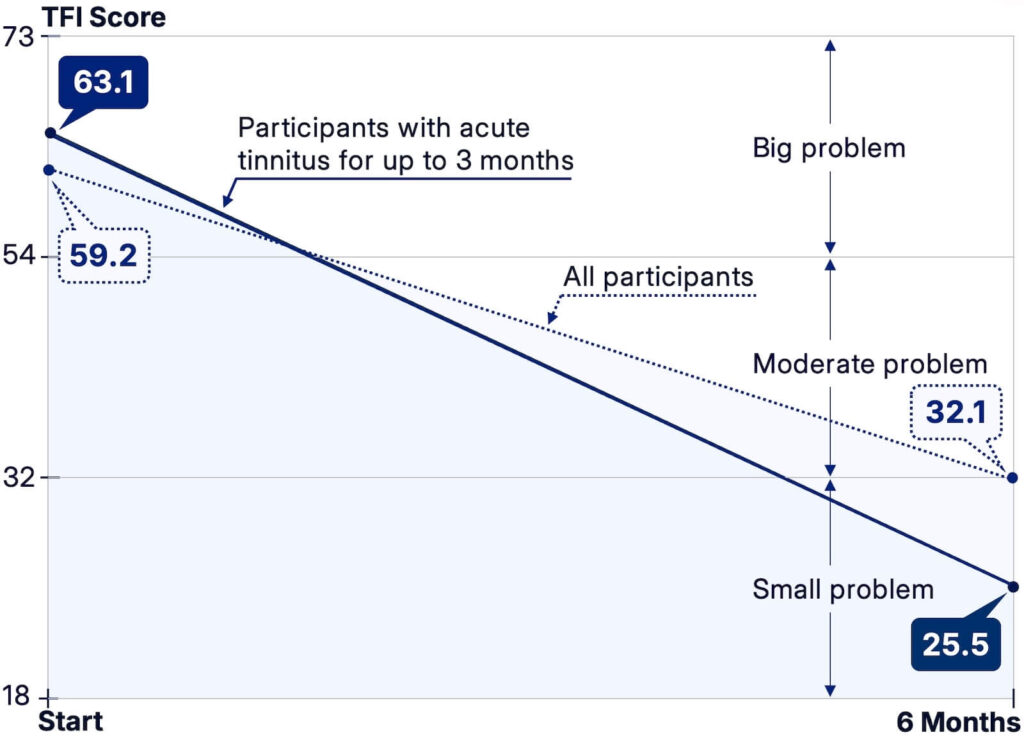
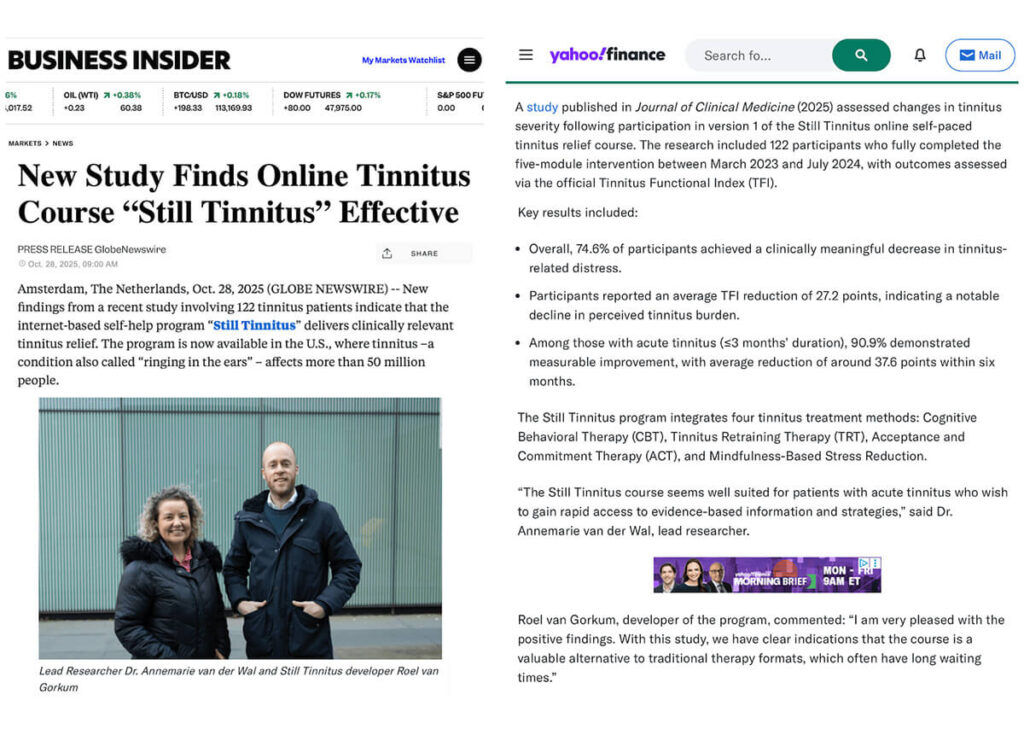
image:
*ST-V1 Study: Van der Wal, et al., Change in Tinnitus Severity After an Online Self-Paced Tinnitus Course: A Retrospective Cohort Study in Acute and Chronic Tinnitus Patients, Journal of Clinical Medicine (2025), PMID 40004696. Download the full peer-reviewed study (PDF).
Success Stories
Recovery stories from Still Tinnitus participants.
Collapse review ▲


Collapse review ▲
Collapse review ▲
Collapse review ▲

Collapse review ▲
Collapse review ▲

Collapse review ▲

Collapse review ▲

Collapse review ▲
Collapse review ▲
Collapse review ▲
Collapse review ▲

Collapse review ▲
Collapse review ▲

Collapse review ▲

Collapse review ▲
Collapse review ▲
Collapse review ▲
Collapse review ▲
Collapse review ▲
Collapse review ▲
Collapse review ▲
Collapse review ▲
Collapse review ▲
Collapse review ▲
Collapse review ▲

Collapse review ▲

Collapse review ▲
Collapse review ▲

Collapse review ▲
Collapse review ▲

Collapse review ▲
How to Get Started
Personalized help without waiting.
Join the free webinar and book a call to determine whether the Still Tinnitus program is right for you.
1
Watch the free webinar
- Get a clear, science-based understanding of why you developed tinnitus and what you can do to calm it down as soon as possible.
- Learn what you should stop doing immediately to avoid making your tinnitus worse.
- Hear real success stories from others and how the Still Tinnitus course helped them reach the point where tinnitus fades into the background.
- The webinar takes 40 minutes and you can ask Roel questions via chat.
- No active participation is required, and your camera and microphone remain off.
2
Book your free tinnitus consultation
- After the webinar, you’ll have the opportunity to schedule a free 15-minute consultation with Roel via Google Meet.
- Together, we’ll discuss whether Still Tinnitus is suitable for you and, if so, which program best fits your needs.
- You’ll either receive an invitation to the course or guidance toward more appropriate treatment options.
- This consultation is completely free, non-binding, and does not obligate you to anything.
3
Start the course
Still Tinnitus Pricing
Country-specific discounts available.
Tinnitus care can be fragmented and expensive. In the U.S. alone, costs can reach $4,500–$7,500+ for consultations, therapy, and devices. The Still Tinnitus program offers a structured program, including direct support from the founder, for $999–$1,999. See full comparison.
Self-directed program
Independent
Independent
Complete self-paced core program, including all modules.
$999$1,199Save $200
Or 3 payments of $369
$999$1199Save $200
Or 3 payments of $369
* I personally support every participant, so spots for the Guided and Premium programs are limited. The Independent program is not. Reduced pricing is available in some countries (see FAQ).
- Calm your tinnitus with the effective five-step Still Tinnitus method
- 10 hours of video lessons based on CBT, TRT, ACT and Mindfulness
- Personal app and workbook with 40+ effective, simple exercises
- Improved sleep and concentration, reduced stress and anxiety
- 2 years of unlimited access to video lessons (can be extended – app and workbook are yours to keep)
- Hyperacusis module1
- Inner Circle module2
- 60-day risk-free guarantee
3 months of guided email support from program founder3Second opinion on your audiogram4Two 1-on-1 coaching calls5
Choose Independent if you prefer working through the structured program and exercises on your own.
To see if this program is right for you, the first step is watching the free webinar.
✓ Most popular
Guided
Guided
Self-paced program + 3 months email support (calls optional at $250 each).
$1,299$1,599Save $300
Or 3 payments of $479
$1,299$1,599Save $300
Or 3 payments of $479
* I personally support every participant, so spots are limited. I have 2 spots left this week, for either the Premium or Guided program. Reduced pricing available in some countries (see FAQ).
- Calm your tinnitus with the effective five-step Still Tinnitus method
- 10 hours of video lessons based on CBT, TRT, ACT and Mindfulness
- Personal app and workbook with 40+ effective, simple exercises
- Improved sleep and concentration, reduced stress and anxiety
- 2 years of unlimited access to video lessons (can be extended – app and workbook are yours to keep)
- Hyperacusis module1
- Inner Circle module2
- 60-day risk-free guarantee
- 3 months of guided email support from program founder3
Second opinion on your audiogram4Two 1-on-1 coaching calls5
Choose Guided if you want reassurance you’re applying the methods correctly, with access to expert guidance.
To see if this program is right for you, the first step is watching the free webinar.
Highest support
Premium
Premium
Self-paced program + 6 months email support + two 1-on-1 calls included.
$1,999$2,499Save $500
Or 3 payments of $739
$1,999$2,499Save $500
Or 3 payments of $739
* I personally support every participant, so spots are limited. I have 2 spots left this week, for either the Premium or Guided program. Reduced pricing available in some countries (see FAQ).
- Calm your tinnitus with the effective five-step Still Tinnitus method
- 10 hours of video lessons based on CBT, TRT, ACT and Mindfulness
- Personal app and workbook with 40+ effective, simple exercises
- Improved sleep and concentration, reduced stress and anxiety
- 2 years of unlimited access to video lessons (can be extended – app and workbook are yours to keep)
- Hyperacusis module1
- Inner Circle module2
- 60-day risk-free guarantee
- 6 months of priority email support from program founder3
- Second opinion on your audiogram4
- Two 1-on-1 coaching calls5
Choose Premium for maximum support including extended email access and one-on-one coaching calls.
To see if this program is right for you, the first step is watching the free webinar.
1 The Hyperacusis module addresses sound sensitivity (hyperacusis), which affects a substantial proportion of tinnitus patients.
2 The Inner Circle module is designed for partners, family members, or friends. It helps them understand tinnitus and learn practical ways to support you.
3 While most questions are addressed in the course, the Guided and Premium programs include on-demand email support from Roel. You may ask anything tinnitus-related, such as personalized troubleshooting, clarification of symptoms and reactions during habituation, and support during challenging periods. Technical email support for access or login issues is included with all programs.
4 The Premium program includes a second opinion on your audiogram, offering my personal review of your hearing. You may submit an audiogram obtained from an audiologist at any time during the program; it does not need to be available at enrollment.
5 The Premium program includes two 1-on-1 coaching calls via Google Meet. Calls may be scheduled at any time within the first 6 months after purchase and are held directly with the program founder, Roel van Gorkum. You may use these sessions to ask questions about your situation and get peronalized advice. Availability in your time zone is guaranteed. Not sure if you’ll need coaching calls? Start with Guided. You can add 1-on-1 calls later at the same price ($250/call). No commitment required now.
Want help finding the right program, or need more information? Ask me during the webinar.
60-Day Risk-Free Guarantee
Try the program without financial stress.
Starting a tinnitus program is an important decision. You should have enough time to genuinely experience whether this structured habituation approach is helpful for you, without feeling financially trapped. If you complete the program, apply the exercises, but feel it isn’t helping you or the online course format isn’t the right approach for you, you will receive a full refund within 60 days of enrollment.
What is required to qualify
Because tinnitus habituation is a gradual process, participants need to actively engage with the program to properly evaluate whether it fits them. To qualify for the guarantee, participants should:
• Complete all the video modules
• Do the exercises in the workbook
• Make a genuine effort to apply the techniques in daily life
This guarantee is based on mutual trust as real progress depends on honest and steady participation.
Important medical note
This program is designed to help participants reduce tinnitus distress and support habituation. While full habituation takes on average 6-18 months, most participants who consistently engage with the program begin noticing positive changes within weeks. As with any treatment, individual results vary and outcomes cannot be guaranteed.
Why this guarantee exists
Many people with tinnitus have already tried treatments that did not help. You should be able to properly evaluate whether this evidence-based approach feels helpful for you without financial pressure. The goal of this guarantee is to support participants who are ready to actively engage with the program and give the method a fair opportunity to work.
Why 60 days?
With an average time commitment of about one hour per week, the course is designed to be completed over approximately eight weeks (or 60 days). This is why the program includes a 60-day guarantee. By the end of these eight weeks, you will have learned and practiced the core skills that support tinnitus habituation. This does not mean that habituation itself is fully complete at 60 days. Full habituation typically unfolds over several months, often in the range of 6–18 months, as the nervous system gradually adapts. However, most participants notice meaningful psychological relief within these first 60 days, such as reduced anxiety, improved sleep, and a greater sense of control.
Habituation.
Habituating to tinnitus is similar to moving houses to live near a church bell or train tracks. At first, the sound startles you and disrupts your sleep. But over time, your brain learns to tune it out, and you barely notice it anymore.
What Is Habituation?
Using the power of neuroplasticity.
Habituation is the process by which your brain gradually stops reacting emotionally to tinnitus, so the sound fades into the background and bothers you less and less. This works by using neuroplasticity, the brain’s natural ability to change and adapt. Over time, tinnitus is processed as a neutral, harmless signal rather than a threat that demands constant attention.
Benefits of habituation
- Less stress and anxiety
- Better sleep
- Improved concentration
- Greater sense of calm and control
- Re-engage in normal daily life
Habituation is currently the recommended evidence-based approach for reducing tinnitus complaints.

What Is Habituation?
Using the power of neuroplasticity.
Habituation is the process by which your brain gradually stops reacting emotionally to tinnitus, so the sound fades into the background and bothers you less and less. This works by using neuroplasticity, the brain’s natural ability to change and adapt. Over time, tinnitus is processed as a neutral, harmless signal rather than a threat that demands constant attention.
Benefits of habituation
- Less stress and anxiety
- Better sleep
- Improved concentration
- Greater sense of calm and control
- Re-engage in normal daily life
Habituation is currently the recommended evidence-based approach for reducing tinnitus complaints.
Habituation.
Habituating to tinnitus is similar to moving houses to live near a church bell or train tracks. At first, the sound startles you and disrupts your sleep. But over time, your brain learns to tune it out, and you barely notice it anymore.
Frequently Asked Questions
Any questions not covered below will be answered during the free webinar.
Who is this course for?
This course is designed for people experiencing significant tinnitus distress. In general, they rate their tinnitus 6 out of 10 or higher. It doesn’t matter what kind of sound you hear (for example, ringing, buzzing, high- or low-pitched), or what the suspected cause is (such as hearing loss, stress, illness, or injury). If you choose to apply after the free webinar, your individual situation is reviewed to ensure the program is an appropriate fit. Patients with pulsatile tinnitus (a sound that follows the heartbeat) typically experience less change in the tinnitus sound itself, but often still report reduced anxiety and stress.
Is this only for people who recently got tinnitus?
Our research suggests that people who begin support earlier after the onset of tinnitus often experience improvement sooner. However, many participants in our program have been living with tinnitus for years. As reflected in our reviews, even individuals who have experienced tinnitus for 10 years or more can still benefit from the course. Many of these participants received little effective support early on and learned to cope on their own—often by avoiding the sound, staying constantly distracted, or using masking strategies. These approaches can work for a time, but they may become exhausting or less effective during periods of increased stress, illness, or major life changes such as retirement. At that point, tinnitus-related distress often becomes more noticeable, and people seek help. When you fill in the application form after the free webinar, your situation is carefully reviewed to ensure the program is an appropriate fit for your needs.
Is this only for hearing loss-related tinnitus?
No, it does not matter whether you have severe hearing loss, mild hearing loss, or normal hearing. More than 80% of tinnitus cases have something to do with hearing, but it can also occur in people with clinically normal or excellent hearing. This course is intended for people with tinnitus regardless of how it started. In the course, you will learn evidence-based ways to relate differently to tinnitus, including how patterns of thinking, attention, and emotional responses can increase or reduce tinnitus-related distress. These approaches aim to help you suffer less from tinnitus and make the sound fade into the background. Your hearing level is not a limiting factor for this process. While hearing loss itself cannot always be changed, how tinnitus affects your daily life can be.
Does this work for tinnitus from stress?
Yes, it is very well suited for stress-related tinnitus. Stress often plays a significant role in tinnitus by increasing awareness and distress. For many people, tinnitus begins or worsens during periods of prolonged stress. This course explains how stress and tinnitus interact and introduces practical stress-reduction strategies using CBT and mindfulness. By calming the nervous system and changing habitual response patterns, you’ll be able to break the stress–tinnitus cycle and experience less daily burden from tinnitus.
I’m on a therapy waitlist, should I first complete that?
On the contrary, supporting science indicates that people who begin learning effective tinnitus coping strategies earlier often experience improvement sooner. Starting the course while you are waiting for in-person care can help reduce distress and give you practical tools during that time. Many people develop unhelpful response patterns—such as constant monitoring, avoidance, or fear-based thinking—simply because they haven’t yet been shown alternative approaches. Addressing these patterns earlier can make them easier to change.
I’m already doing something else, can I combine it with this course?
Yes, the Still Tinnitus course can be safely used alongside other forms of care, including cognitive behavioral therapy (CBT), mindfulness-based treatments, and audiological care. If you are experiencing high levels of stress or burnout, a combined approach is often helpful. You may choose to use the course to address tinnitus-related distress while also working with a psychologist on stress management, burnout recovery, or relapse prevention. Your physician or ENT specialist may also recommend additional evaluations, treatments, or medications. These can generally be used safely alongside the course, as the program is educational and does not interfere with medical care.
How does Still Tinnitus compare to other treatments?
A side-by-side comparison can be found here.
How long will it take to see results?
If you follow the lessons and practice the exercises consistently, people often begin to notice early improvements within a few weeks—most often as reduced stress, fear, or reactivity to the tinnitus sound. Over time, feelings such as powerlessness, frustration, and anxiety typically lessen gradually rather than all at once. Reaching a stage where tinnitus has little or no impact on daily life (a process known as habituation)—varies from person to person. For many, this process unfolds over approximately 6 to 18 months, depending on individual factors and consistency of practice.
What is the course based on?
This course is grounded in four well-established, evidence-based approaches used in tinnitus care:
- Cognitive Behavioral Therapy (CBT)
- Tinnitus Retraining Therapy (TRT) (without sound maskers)
- Acceptance and Commitment Therapy (ACT)
- Mindfulness-based approaches
The Still Tinnitus 5-Step method integrates insights from leading clinical and scientific work by internationally recognized experts, including Dr. Pawel Jastreboff, Dr. Jonathan Hazell, Dr. Laurence McKenna, Dr. James Henry, Dr. Steven Hayes, and mindfulness pioneer Dr. Jon Kabat-Zinn.
What will I learn in this course?
In this course, you’ll learn how to significantly reduce the impact tinnitus has on your life by accelerating the process of habituation. Using four evidence-based approaches, you’ll learn how to change your response to tinnitus so it becomes less intrusive, less stressful, and easier to ignore over time. You’ll practice skills that help your nervous system calm down and retrain how tinnitus is processed. As this happens, many people find that tinnitus no longer bothers them and fades into the background.
What’s the advantage of habituation?
Habituation is the process by which your brain gradually stops reacting emotionally to tinnitus, so it fades into the background and bothers you much less. Over time, habituation leads to real-life benefits such as:
- Less stress and anxiety
- Better sleep
- Improved concentration
- More peace of mind
- Ability to resume normal daily life
I’m not great with computers, is this for me?
You don’t need to worry about age or technical skills. People between 17 and 83 years old have successfully completed the course. The online platform is designed to be simple and easy to use, even if you’re not very comfortable with technology. And if you do run into any difficulties, email support is available and you’ll receive personal help. If you have any other questions, feel free to ask them during the free webinar.
How does the course work?
After completing your registration, you receive immediate access to a clear, user-friendly course platform. You’ll be able to download your workbook, access the supporting app and follow the course from your computer, tablet, or smartphone. The course is fully online and can be accessed from anywhere with an internet connection. During the access period included with your chosen program, you can revisit lessons and exercises as often as you like, allowing you to move at your own pace and repeat sections whenever needed.
Will I be able to revisit the course?
Yes. Depending on the program you choose, you’ll have unlimited access to the online course for at least two years, with an option to extend access. During this time, you can revisit lessons and exercises as often as you like, at your own pace. Your workbook, notes, and meditation exercises are yours to keep forever.
How long does it take? When does it run?
The full course takes approximately 8 hours to complete in total. It is recommended to spend no more than 1 to 2 hours per week, allowing time for practice and integration. At a pace of about 10 minutes per day, or roughly 1 hour per week, most people complete the course in around 8 weeks. All lessons are pre-recorded and self-paced, so there are no fixed start dates or schedules. You can begin immediately, move through the material at your own pace, pause if needed, and return to it later. After completing the course, you continue applying and practicing what you’ve learned as part of daily life.
What does it cost and what is reduced pricing?
Prices depend on the chosen program and your country of residence to improve accessibility for lower-income regions. You always have the option to pay in 3 monthly instalments. Full pricing details are explained during the free webinar. This allows you to see which option best fits your situation before deciding whether to continue. Participating in the webinar does not obligate you to anything. Prices can be found here.
Do you offer guarantees?
Yes, we offer a 60-day risk-free guarantee which is explained here.
Is my data private and secure?
We follow strict data security protocols and never sell your data. See our Privacy Policy for details.
Are you a doctor?
No, I am not a doctor, but an engineer with a Master of Science in Biomedical Engineering and have specialized training in tinnitus care. I am among a small group of professionals who have received Tinnitus Retraining Therapy (TRT) certification from Dr. Pawel Jastreboff. In addition, I have been trained in Acceptance and Commitment Therapy (ACT), Cognitive Behavioral Therapy (CBT), and mindfulness-based approaches, including training informed by the work of Dr. Steven Hayes and colleagues. After developing tinnitus myself, I combined these evidence-based approaches with leading research in the field to develop a structured method. This approach has helped me and many others reach a point where tinnitus no longer dominates daily life. Because I live with tinnitus myself, I also understand firsthand how disruptive and distressing it can be, and that perspective informs how the course is designed and taught.
How do I enroll?
Click the button below to register for the free webinar. The 3-step process to enroll in the course is outlined here.