Do you have tinnitus and notice that everyday sounds feel too loud—or even painful? If so, you may be experiencing hyperacusis. Research shows that over 40% of tinnitus patients also struggle with hyperacusis.
I know how frustrating it can be, because I had the same. When I first developed tinnitus, I invited some friends over, and one of them laughed so loudly that I had to cover my ears with my hands. It felt unbearable!
Thankfully, my hyperacusis went away completely, and in this article, I’ll explain how you can achieve the same.
What is hyperacusis?
Hyperacusis is a condition where you become overly sensitive to external sounds. The word comes from ancient Greek: “hyper” means excessive and “akousis” means hearing. So literally, hyperacusis means “excessive hearing.” In practice, this means that sounds that used to seem normal can suddenly feel much louder than they are—and sometimes even painful.
Key facts about hyperacusis
- Hyperacusis is sound sensitivity that makes normal noises seem overwhelming.
- Everyday sounds like laughter, clinking cutlery, or traffic may feel unbearably loud.
- It often occurs alongside tinnitus, but it can also appear independently.
5 Signs you might have hyperacusis
If you recognize multiple of the following signs, there’s a good chance you are dealing with hyperacusis:
- You can’t tolerate loud environments that never bothered you before.
- Everyday sounds like dishes clattering, kids playing, or people laughing feel too loud.
- Certain noises actually cause physical discomfort or pain in your ears.
- You’re constantly worried about protecting your ears and often wear earplugs in situations where they aren’t needed, like at the cinema or in restaurants.
- You’ve started avoiding activities involving sound, such as listening to music or social outings, because of the discomfort.
In my experience, many people feel relieved just knowing that these struggles have a name—and that recovery is possible.
What causes hyperacusis?
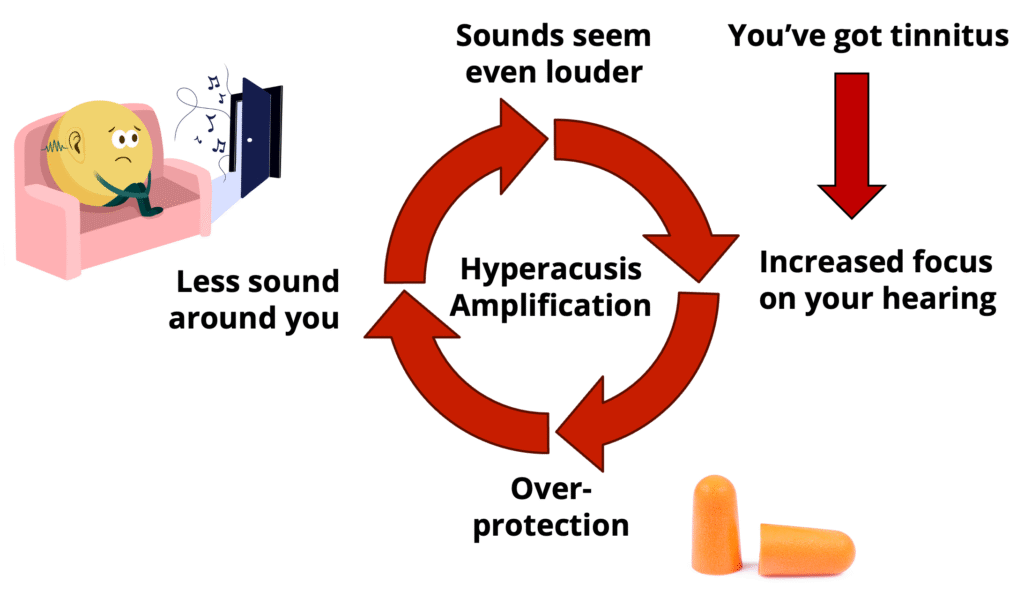
Hyperacusis often begins with tinnitus. But the surprising part is that your own behavior can unintentionally make it worse. Here’s how the cycle usually develops:
The cycle of hyperacusis
This is how you develop a vicious cycle that creates and worsens hyperacusis, which is similar to the vicious tinnitus cycle.
- You develop tinnitus and start paying close attention to your hearing.
- You learn that tinnitus is often linked to hearing loss and worry that sound exposure makes it worse.
- To protect yourself, you use earplugs or noise-canceling headphones in everyday situations, even when they aren’t necessary.
- With less sound exposure, your brain “turns up the volume,” making everything feel louder.
- This makes you more anxious, which leads you to protect your ears even more—trapping you in a vicious cycle.
This cycle is exhausting, but the good news is that you can break free from it.
How to stop hyperacusis
While severe hearing loss may reduce the chances of completely eliminating hyperacusis, most people can improve dramatically—or recover fully. The key lies in calming your nervous system and addressing the tinnitus-hyperacusis cycle together.
Steps toward improvement
- Focus on improving your tinnitus rather than obsessing over protecting your ears.
- Gradually allow yourself to experience normal sound environments again.
- Practice relaxation techniques to reduce the nervous system’s overreaction to sound.
- Learn to retrain your brain to perceive everyday noises as normal again.
- Follow my hyperacusis training included with the Still Tinnitus course
In my own journey, my hyperacusis disappeared completely once I started working on my tinnitus and calming my system. The same might be possible for you!
Free Tinnitus Training
If you found this helpful, I recommend joining my free tinnitus webinar. There, I will explain how the Still Tinnitus method can help you to calm your tinnitus and reclaim your life, without traveling, wait times, or group sessions. Even though there’s no cure for tinnitus, a full recovery is possible. Hang in there, and see you in the webinar!