Nice picture right? Sunshine, nice beach, a smiling face. But what you don’t see is the loud ringing in my ear that made me feel utterly miserable.
I had spent $2,000 on a trip to a tropical island, desperately hoping that a week of relaxation would stop my tinnitus. I’d read that stress was the root cause, and this felt like a last resort. Unfortunately, even that didn’t help me.
But that trip did become a turning point: it planted the seed for my eventual recovery.
How It All Began: A Burnout and a Crash
Many years ago I was working at ASML, the largest chip machine manufacturer in the world. I lived in Amsterdam and commuted long hours. My days started at 6 AM and ended in traffic jams after back-to-back meetings and customer complaints. It didn’t suit me, and eventually, I hit a wall: I burned out.
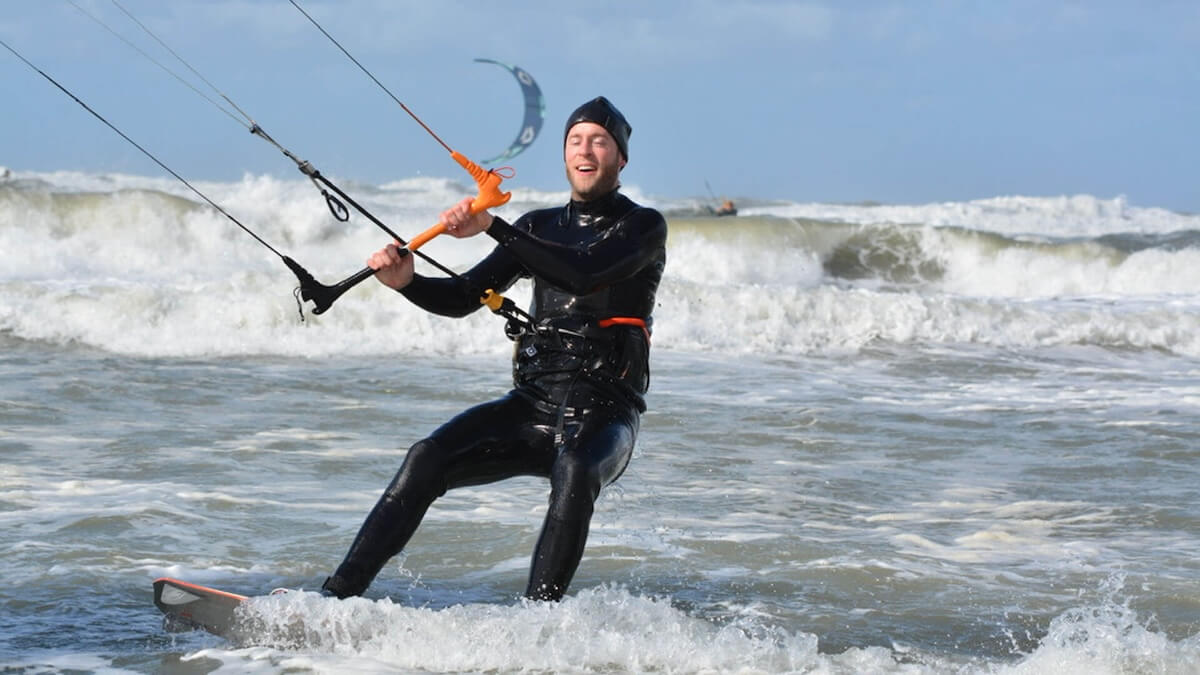
I became homebound for a while. During that time I went kitesurfing and unfortunately a wave hit my left ear. A sharp, high-pitched ringing followed. I’d heard it before, but this time it stayed. The next morning, it was still there!
I immediately thought of a woman who was in the mindfulness course I had participated in. During one of the sessions, she started crying and told us about the constant ringing in her head. She said it drove her crazy and there was nothing that could be done about it. I remember thinking, “Oh my god, I never want that to happen to me!”
So when I heard the ringing myself, that’s what I thought of.
Panicking and Searching for Solutions
A quick search on Google only made things worse: no cure, no reliable treatments and endless negative stories. Maybe you recognize this: frantically looking for answers online, desperately hoping to find something reassuring.
I was constantly checking whether the sound was still there. I would go to the bathroom (where it was quiet), hold my fingers to my ears and listen. It became an obsession that didn’t help: the ringing only grew louder.
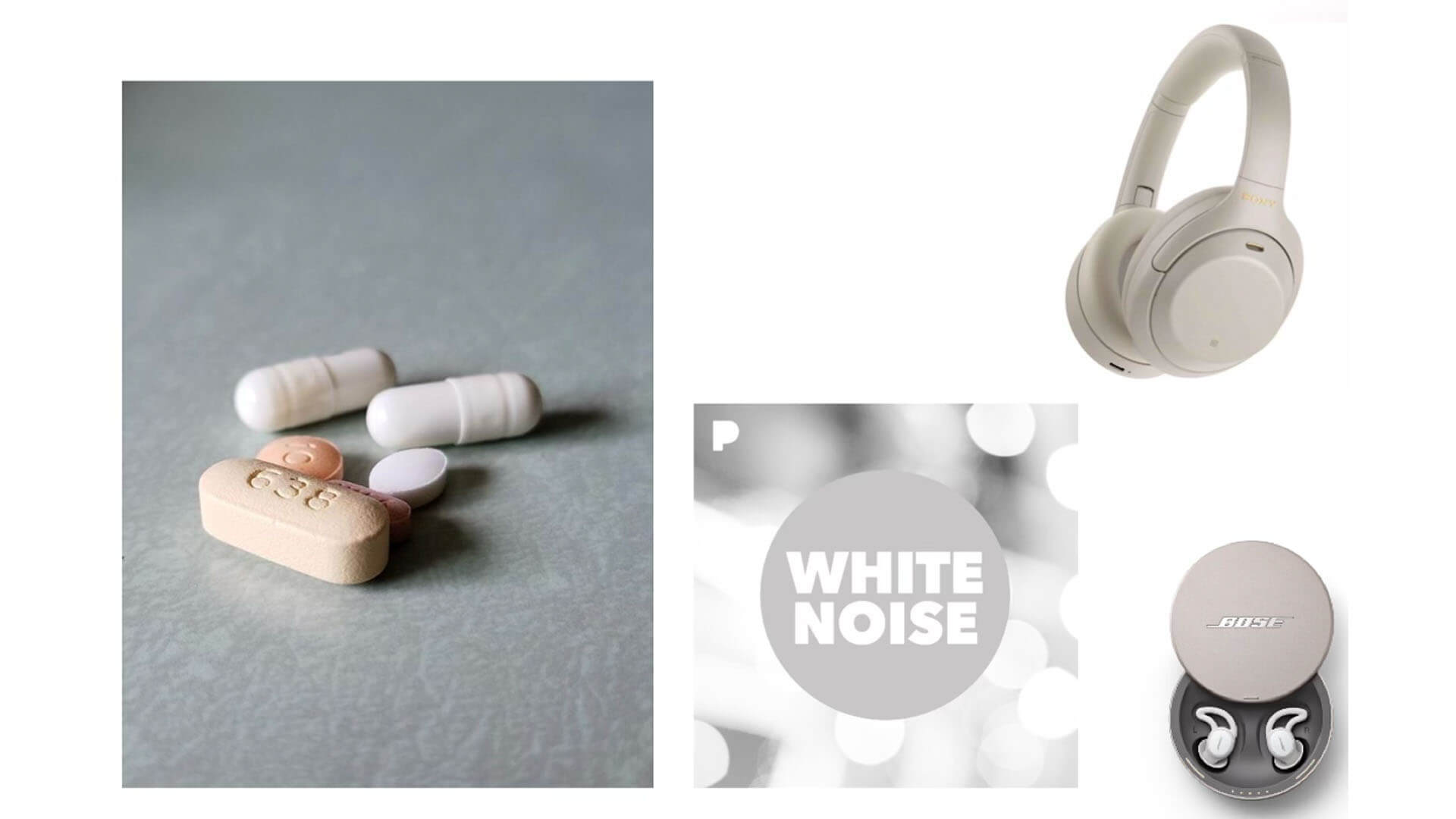
As my desperation grew, I ordered ginkgo biloba pills from Amazon in Germany because they weren’t easily available in the Netherlands, and some online forums claimed they might help. I bought noise-canceling headphones and wore them all day because I wanted to protect my ears. Bose sleep earbuds. A sound masking machine. The $2,000 beach vacation. Nothing worked.
Hyperacusis and Sleep Problems
Because I was wearing the noise-cancelling headphones a lot, I deprived my ears of sound. I used to love to go to music festivals, which I stopped doing. I didn’t listen to music at home anymore, because I was afraid it would make my tinnitus worse. I started to over-protect my ears, meaning I was wearing earplugs in the cinema and in other occasions where that was not really needed.
This behaviour, combined with my anxiety for tinnitus, introduced a new problem: hyperacusis. I became hyper-sensitive to sound, and normal sounds even started to feel like they hurt my ears. I remember a friend laughing loudly in my living room and instinctively covering my ears with my hands because it hurt!
It was shaping my life around protecting my ears, and in doing so, I was actually making things worse. Now, stress and fear started to disrupt my sleep. I’d have nightmares where my tinnitus was 10 times louder. I’d wake up to an unbearable sound, confused and scared. I hadn’t damaged my ears in my sleep, so why was it worse? I didn’t know back then that tinnitus is amplified by stress and that my own fear was feeding it.
Nathalie’s Success Story
“Already after the first few classes, I could sleep calmly, shift my mindset and understand what was going on in my head and brain. It’s been a few weeks now that I have finished the course and the tinnitus is not affecting my life at all anymore.”— Nathalie / Read more success stories here→
A Hearing Test Provided No Relief
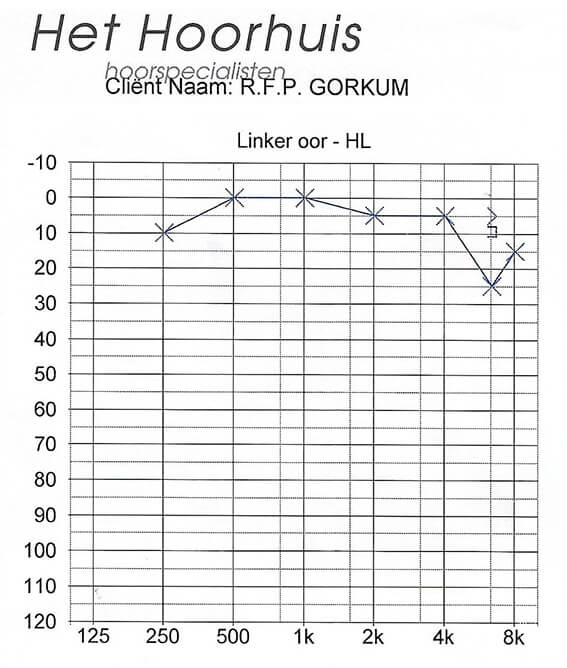
My doctor referred me to an audiologist for a hearing test. The audiologist told me my hearing was actually quite good for my age, except for a noticeable dip right at the frequency where I experienced the tinnitus. She mentioned this was frequently seen in people who like to go out without hearing protection.
That detail hit hard. Instead of feeling reassured, I felt ashamed and furious! How could I have been so careless? Why hadn’t anyone told me that those school parties, loud concerts, or even kitesurfing without ear protection could leave permanent damage?
I Started Doing Research To Find A Cure
I looked for help but found very little. There was apparently some group therapy, which involved a waiting time of 5 months and a long commute. It would involve talking to other people with tinnitus in a group, which really didn’t appeal to me. I didn’t want to hear more desperate stories from others. What if there was someone with suicidal thoughts or something like that? I didn’t want to talk to strangers, I wanted a solution.
So I turned to what I had done before for my Masters in BioMedical Engineering: my own literature research. Instead of feeling a victim, I started to approach this problem the way I had learned to approach complex challenges during my studies: by breaking it down, understanding the mechanisms, and testing solutions step by step.
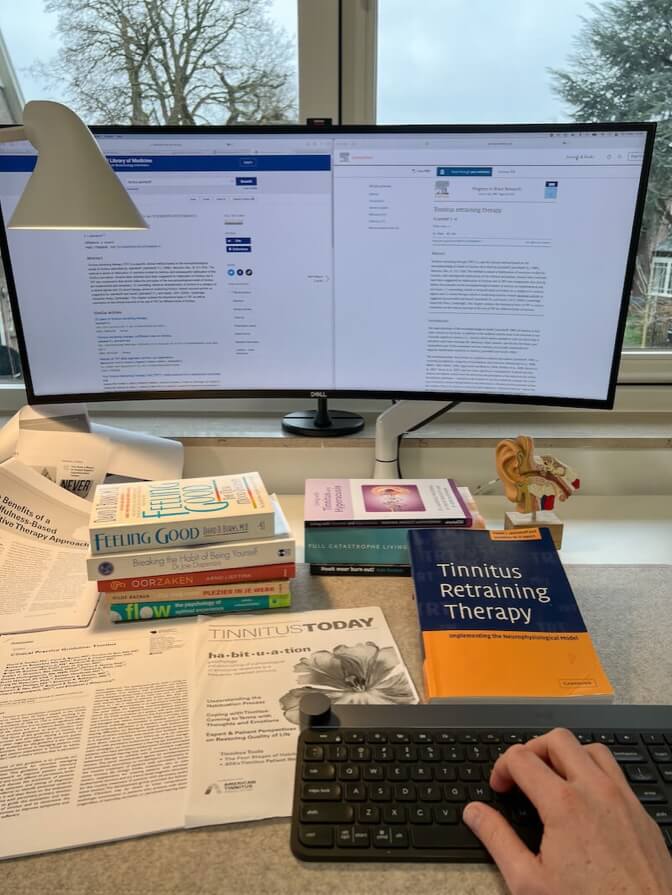
I started reading scientific studies about tinnitus on PubMed and discovered there were real tinnitus experts out there. Sitting at my computer until late at night, I read everything I could find. I discovered several scientifically proven tinnitus treatments that were used in different countries around the world. Slowly, I got hope again: there wás something that could be about tinnitus!
I also bought every serious book about tinnitus I could find. The first book that truly helped me was Tinnitus Retraining Therapy by Dr. Pawel Jastreboff and Jonathan Hazell. Later, when I developed my tinnitus relief course I even joined a 60-hour training and got certified in TRT by Dr. Pawel Jastreboff himself.
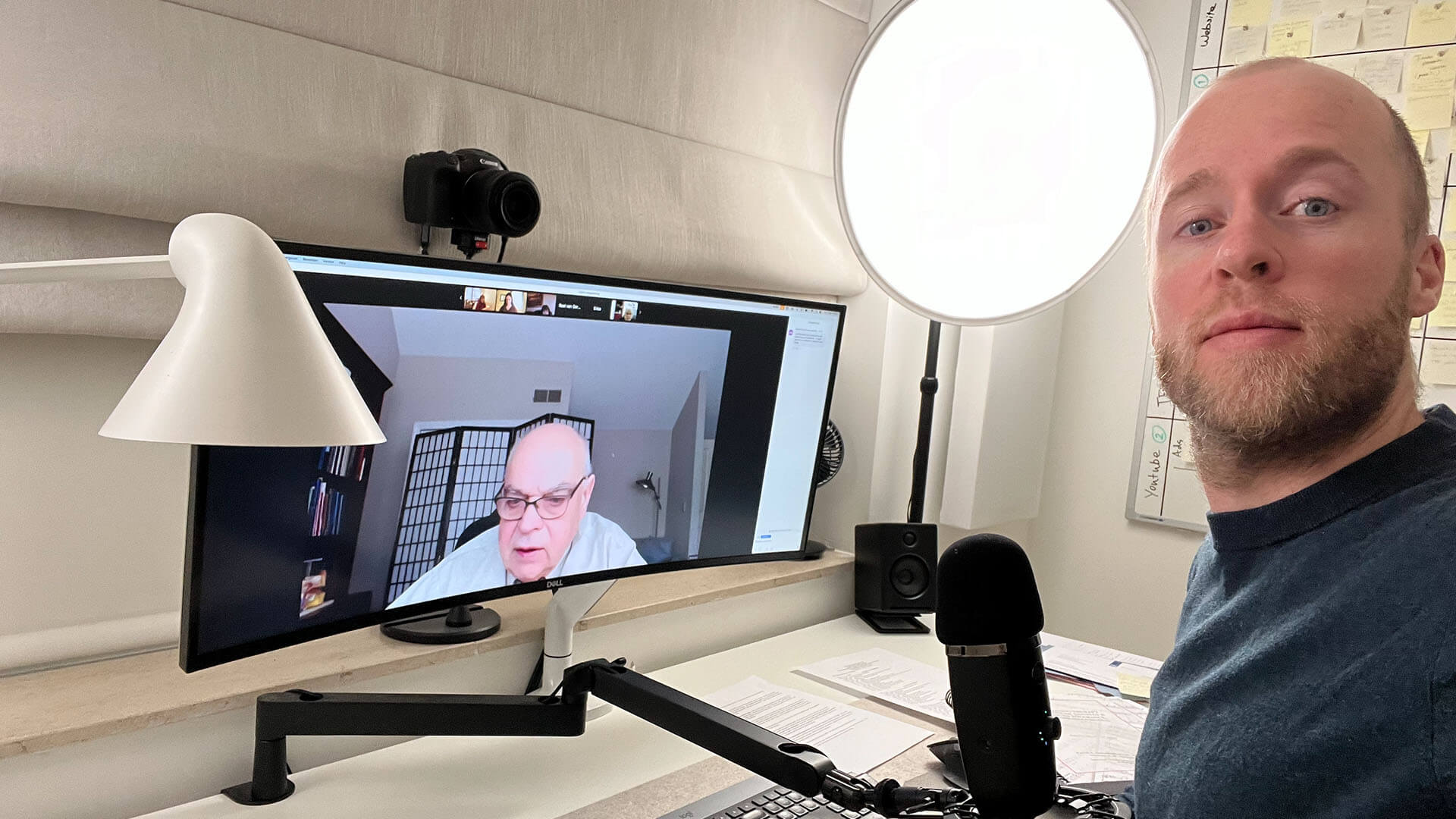
Apparently, Cognitive Behavioural Therapy and Acceptance and Commitment Therapy could also be used to improve tinnitus complaints. My mindfulness training became useful again. I started meditating and tried to accepting the sound instead of constantly fighting it and running away from it. I even began to find tinnitus fascinating!
I learned that masking sounds, if applied correctly, could actually help your brain adjust more quickly. That tinnitus itself isn’t dangerous. And most importantly, that my own reaction to the sound was making tinnitus worse!
I packaged everything I could find that worked for me into a new method and tried that out on myself through a lot of trial-and-error. I threw away my earplugs and made a decision: no more fear, screw this sound!
My Method Worked!
Slowly, things started to shift. For the first time in months, my anxiety started to drop. Not overnight, and not in a straight line, but something changed. My sleep improved. I wasn’t constantly bracing myself for the next spike in sound. The tinnitus was still there and didn’t yet change much in volume, but it no longer had the same grip on me. There were bad days, of course, but they didn’t derail me the way they used to. I started to suffer less and less.
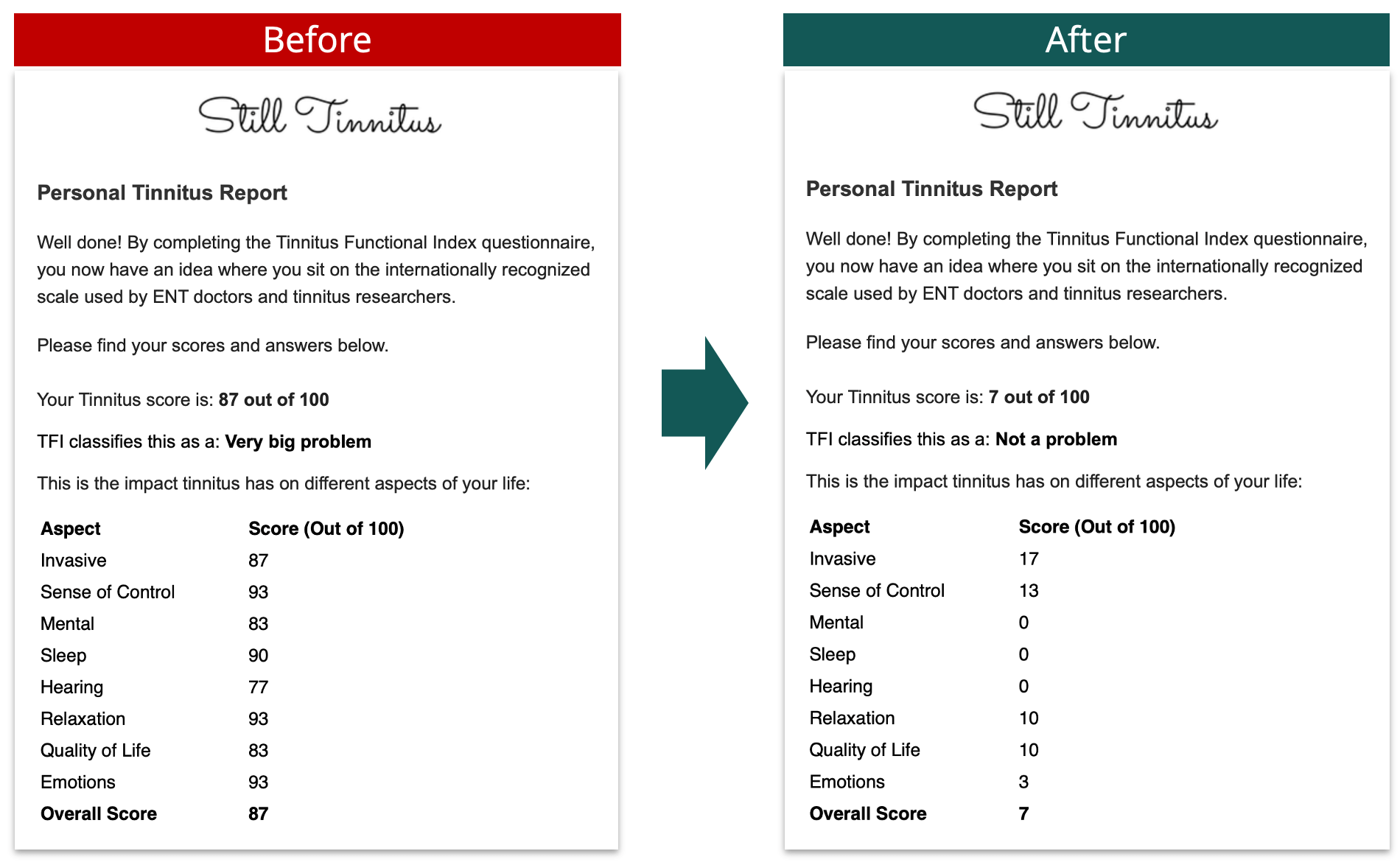
Over the next months, my complaints decreased and I started to hear my tinnitus less, and less loud as well. My Tinnitus Functional Index (TFI), a clinical scale that measures the impact of tinnitus, started at 87, a ‘very big problem’. Over time, it dropped to just 7: no problem. I now have days when I hear nothing at all. I also have days when tinnitus is louder, but even then it doesn’t bother me. I know what to do (and what not to do!) and usually the next day it has gone back down again.
You can get your own Tinnitus Functional Index score for free here, by the way.
Let Me Help You Too
Tinnitus no longer defines my life. I have great sleep. I no longer use masking sounds. I go to music festivals. I often enjoy full days of silence. And even when the sound returns, I no longer fear it. When I look back at that photo on the beach, where I looked happy but felt completely lost, I feel proud. Because I was able to solve tinnitus myself and made it my mission to help 10.000 people achieve the same.
If you found this helpful, I recommend joining my free tinnitus webinar. There, I will explain how the Still Tinnitus method can help you to calm your tinnitus and reclaim your life, without traveling, wait times, or group sessions. Even though there’s no cure for tinnitus, a full recovery is possible. Hang in there, and see you in the webinar!