If you’re already using sound therapy or thinking about starting, listen up. I stopped using tinnitus sound therapy, except under very specific conditions I’ll tell you about later in this blog. I learned that if sound therapy is used the wrong way, it can actually make your tinnitus worse and stop you from getting better. You’re probably making the same mistakes that I did.
Even if you think you know what tinnitus sound therapy is, let me quickly explain it.
What Is Tinnitus Sound Therapy?
Imagine you’re in a dark room. The only thing in the room is a candle. What’s the first thing you’ll focus on?
The candle. The contrast with the dark room makes it stand out even more.
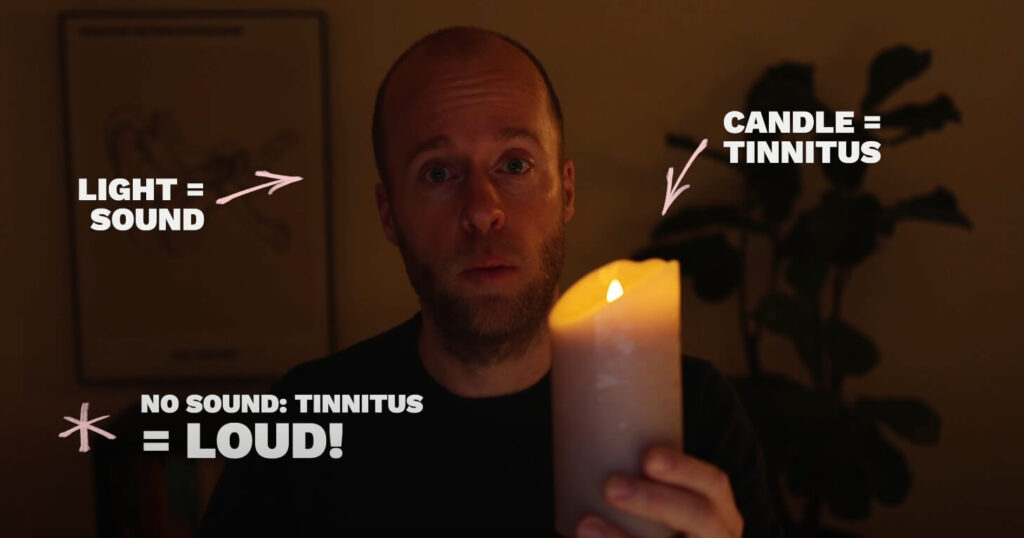
Now imagine the candle is your tinnitus, and the light in the room is sound. When there’s no sound (or no light), the tinnitus feels very noticeable because there’s nothing else for your brain to focus on. But if I turn on the light, your brain has other things to focus on besides the candle. The tinnitus becomes less noticeable.
Here’s another way to think of it: say you’re walking down a busy street with lots of noise and activity. You’ll notice your tinnitus less than if you’re sitting alone in a silent room. The surrounding sounds make the tinnitus feel less loud by comparison.
Sound therapy works on this principle. You add external sounds, called masking sounds, to distract yourself from your tinnitus. So how is sound therapy applied?
Sound Therapy Options
In general, there are 3 options for sound therapy:
- Expensive and old-fashioned ear-level sound generators. These are small devices, like hearing aids, that play white noise or other masking sounds all day.
- Simply playing sounds by listening to music or nature sounds.
- Apps dedicated to playing masking sound via your phone speaker or headphones.
But regardless of which option you choose, I’ve discovered something very important after years of research and trial and error. If sound therapy is applied incorrectly, or used on its own, it can actually prevent you from getting better.
Why? Because if you truly want to reduce your tinnitus, you need to accept it and listen to it, not mask it all the time. Let me explain with a comparison.
The #1 Mistake to Avoid in Sound Therapy
Say you were attacked by a dog as a child. Nothing serious happened, but you’ve been scared ever since. Whenever you see a dog, you walk around it in a wide circle. If it barks, your fear worsens.
Next time, you don’t just walk in a wide circle around the dog. No, you stop and turn around.

Eventually, you don’t even need to see a dog to feel scared. Just hearing one bark in the distance makes you turn around and go home. Over time, you only go for walks at times or places where there are no dogs. Your fear grows stronger because you keep avoiding it.
Now replace the dog with tinnitus. You hear tinnitus, you’re afraid. You want to get rid of it. You don’t want to hear it. So what do you do? Sound therapy. You turn on masking sounds as often as possible. When you’re home, you’ll play music. When you’re going out, you’ll wear your headphones playing white noise. When you come home after work, you’ll be scared because you’re going to sit down on the couch and hear your tinnitus. You don’t want that. So as soon as you come home, you turn on the TV.
Why Masking Your Tinnitus Can Make Things Worse
When you constantly try to drown out your tinnitus with masking sounds, you’re actually reinforcing the fear associated with it. It’s like hiding from that barking dog where your brain learns that tinnitus is dangerous, and that avoidance is the only option. But this fear loop is precisely what keeps your tinnitus distress alive.
The part of your brain responsible for this fear reaction is your primal brain, the same system that once helped our ancestors escape from predators. Back then, if a tiger jumped out of the bushes, your fight or flight system would kick in: your heart rate would rise, your blood pressure would spike, adrenaline pumping. That same system is still active today, but instead of reacting to a tiger, it’s now triggered by tinnitus.
This is why constant masking becomes exhausting. You’re running from tinnitus, not facing it. Maybe you’ve had thoughts like, “I’m going to work and can’t use white noise, my tinnitus is going to be unbearable!” That kind of thinking locks you into a state of fear without any actual improvement.
To break this cycle, you need to stop running. Imagine walking toward that barking dog, eventually petting it, until you’re no longer afraid. The same principle applies to tinnitus. If you never give your brain the chance to hear tinnitus without reacting, your nervous system will keep seeing it as a threat, and keep making it worse.
So instead of masking nonstop, learn to hear your tinnitus without panic. That’s when habituation becomes possible.
What Habituation Really Means
Think of visiting a friend. At first, you notice the buzzing fridge in the kitchen. It’s annoying. But as you start talking and enjoy the moment, the sound fades from your awareness. Later, as you leave, you hear the fridge again, and realize you hadn’t noticed it at all.
That’s habituation.
Your nervous system hears a sound, decides it’s not dangerous, and tunes it out. With tinnitus, this means your brain no longer triggers stress when it notices the ringing. And over time, many people even report that the sound becomes softer or disappears entirely for long periods. When it returns, it doesn’t bother them, and that calm response helps it fade again.
Why Sound Therapy Alone Doesn’t Work
If you’re trying to fix your tinnitus with sound therapy alone, you’re likely setting yourself up for disappointment. It might help in the short term, but it won’t lead to real relief. That said, sound therapy, also called tinnitus masking, can still be useful.
Sound therapy works when it’s :
- Applied correctly
- Used in the right situations
- Combined with other therapies
This isn’t just personal experience. An international review of tinnitus guidelines by leading researchers found that Tinnitus Retraining Sound Therapy alone is outdated and no longer recommended. The evidence simply doesn’t support it as a standalone solution.
So don’t waste months or years on trial and error continuously masking your tinnitus with white noise apps and ocean sounds. That’s exactly what I did, and it didn’t work.
What Actually Leads to Tinnitus Relief
Here’s what 6 years of research and experience have taught me.
My Sound Masking Rules
- Sound therapy is not a cure. On its own, it just distracts you temporarily.
- If you use it, use it right. The sound type, volume, and timing matter. Follow the TRT protocol and work with someone who understands it.
- Combine it with other therapies. Cognitive Behavioral Therapy (CBT), Acceptance and Commitment Therapy (ACT), mindfulness, and TRT can make a real difference, especially when used together.
That’s how you build real, long-term relief from tinnitus. Not by avoiding the sound, but by changing your brain’s response to it.
Free Tinnitus Training
If you found this helpful, I recommend joining my free tinnitus webinar. There, I will explain how the Still Tinnitus method can help you to calm your tinnitus and reclaim your life, without traveling, wait times, or group sessions. Even though there’s no cure for tinnitus, a full recovery is possible. Hang in there, and see you in the webinar!